Loyalty programs are often evaluated too narrowly. Their costs are visible, immediate and easy to measure, while much of the value they create is spread across customer behaviour, marketing efficiency, strategic decision making, partnerships and new revenue streams. As a result, the business case often comes down to one question. Did members spend more?
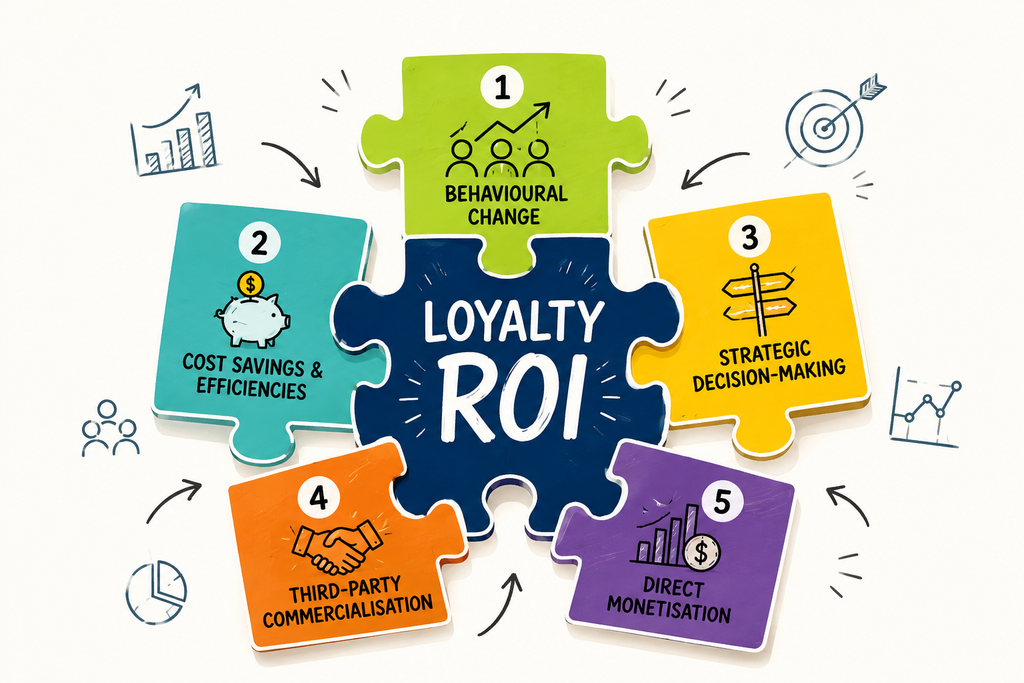
Spend uplift matters, but it captures only one part of the commercial value a loyalty program can generate. There are five distinct sources of value, and understanding them provides a more complete view of loyalty ROI.
What Are the Five Sources of Loyalty Program Value?
| Category | Value generated | How value is measured |
|---|---|---|
| 1. Behavioural change | Incremental acquisition, spend, retention and advocacy | Control groups, holdouts and member versus non-member analysis |
| 2. Cost savings & efficiencies | Lower marketing costs, protected margin and more efficient operations | Historical benchmarks, campaign baselines and cost measures |
| 3. Strategic decision making | Better location, proposition, positioning and investment decisions | Financial impact against a defined counterfactual |
| 4. Third party commercialisation | Revenue and margin from partners, advertisers and suppliers | Revenue and contribution margin by commercial arrangement |
| 5. Direct monetisation | Revenue from subscriptions, service fees and proprietary products | Incremental revenue and contribution margin |
Why Are Loyalty Programs Often Treated as a Marketing Cost?
The accounting treatment naturally reinforces this perception. Reward costs, platform fees and campaign expenditure appear as immediate outflows. The value created through incremental spend, retention, customer insight and better decisions is often dispersed across the business and realised over time.
The result is a simple imbalance. The cost of loyalty is easy to see, while its value is harder to isolate.
When a program is assessed primarily through its cost line, the natural response is to reduce costs. That can mean lowering reward value, limiting benefits or cutting investment. These decisions may improve the short term P&L while weakening the behaviours the program is designed to influence.
Looking at the five sources of value provides a better diagnostic. A program may generate significant data or efficiency value without materially shifting spend. Another may drive strong behavioural change while leaving other opportunities untapped.
1. How Do Behavioural Changes Generate Incremental Revenue?
Behavioural change is closest to the traditional purpose of loyalty. The objective is to influence customers in ways that create incremental value through acquisition, spend, retention or advocacy.
Incremental acquisition
Loyalty programs can increase the value of newly acquired customers while reducing the cost of acquiring them.
Join incentives, structured onboarding and early rewards can encourage customers to engage sooner and establish repeat purchasing behaviour. A differentiated loyalty proposition can also give customers a reason to choose one brand over another beyond price.
Referral programs make the relationship particularly direct. Existing members introduce new customers in exchange for a reward, turning the member base into an acquisition channel.
The key measures are average revenue per new customer and cost per acquisition, with the focus on improvement attributable to the program.
Incremental spend
Membership alone does not necessarily increase spend. The greater opportunity comes from engagement.
McKinsey found that active loyalty members spend around 10% more than enrolled but inactive members, while members who redeem spend around 25 per cent more than the enrolled and inactive group, in Next in loyalty: eight levers to turn customers into fans.
This makes redemption an important behaviour, not simply a program cost. Programs that optimise for low redemption may reduce reward costs while also limiting the behaviour those rewards are intended to stimulate.
Mecca Beauty Loop provides a practical example. Members collect quarterly Beauty Loop boxes in store, creating another reason to visit when they are highly engaged with the brand. The value extends beyond the samples to the incremental spend that visit may generate.
Incremental retention
Retention value comes from customers remaining active for longer than they otherwise would have, preserving future revenue and customer lifetime value.
The relevant comparison is the incremental cost of retaining a customer against the cost of replacing them through acquisition. Retention costs should therefore focus on expenditure used specifically to influence the outcome, such as a targeted incentive to prevent churn.
Without this distinction, retention can appear artificially expensive and lead businesses to prioritise acquisition even when keeping an existing customer creates greater value.
Incremental advocacy
Loyalty programs can also turn engaged members into advocates.
This can be tracked through NPS, referrals, reviews, social engagement and ultimately the customers or revenue generated through those activities. Referral programs provide the clearest commercial link by converting advocacy directly into an acquisition channel.
How behavioural value varies by industry
The most valuable behaviour varies by industry and business model. High frequency businesses may focus on increasing spend and share of wallet, subscription businesses on retention, and lower frequency categories on acquisition, repeat purchase and advocacy.
| Industry | Typical priority | Why |
|---|---|---|
| Telecomunicaciones | Retención | Recurring spend makes churn reduction a major source of value |
| Supermarkets | Spend stimulation | Existing frequency creates opportunities to increase basket size and share of wallet |
| Specialty retail | Acquisition and advocacy | Lower frequency and greater competition increase the importance of acquisition and repeat visits |
Several principles in the Essential Eight™ support these outcomes. Early rewards can accelerate engagement, proposition clarity helps members understand the value available, and desirable rewards encourage redemption.
2. Where Do Loyalty Programs Create Cost Savings and Operating Efficiencies?
Cost savings can be easier to substantiate than incremental revenue because they sit closer to observable expenditure. Loyalty programs can improve marketing efficiency, protect margin and support better operational decisions.
Marketing efficiency
A loyalty program creates a direct channel to identified customers, reducing reliance on paid media and allowing offers to be targeted using known customer behaviour.
This can lower the cost of reaching existing customers while reducing wasted spend. Linking campaign exposure and response at an individual level also creates a faster feedback loop, particularly when supported by control groups and A/B testing.
This becomes increasingly valuable as reaching customers through major digital advertising platforms becomes more expensive and access to customer level data more constrained.
Margin protection and yield optimisation
Loyalty programs can deliver customer value without relying on broad discounting. Loyalty currency, targeted rewards and benefits allow businesses to concentrate value among the customers and behaviours that matter most while protecting headline pricing.
Airlines provide an early example. Instead of heavily discounting unsold inventory and weakening pricing integrity, airlines use loyalty currency and reward inventory to deliver value selectively. Loyalty & Reward Co explores this relationship in Loyalty and Revenue Management Explained.
Mecca’s Beauty Loop demonstrates the same principle differently. Where beauty brands fund product samples, members receive meaningful perceived value at relatively little direct cost to the retailer.
Inventory and operational efficiency
Member transaction data provides visibility into who is buying, what they buy, where they buy it and how those patterns change over time.
Integrated into demand forecasting and inventory planning, this can improve stock allocation, ranging, replenishment and distribution. The resulting value may include lower holding costs, fewer stockouts and markdowns, reduced fulfilment costs and less excess inventory.
The program does not create these savings on its own. It creates a richer customer data asset that can improve operational decisions.
The trade off
Efficiency should not come at the expense of effectiveness. Lower cost rewards and tighter program economics only create value while the proposition remains strong enough to influence behaviour.
If members perceive the program as poor value, engagement falls and the apparent saving can ultimately destroy value elsewhere.
3. How Does Program Data Improve Strategic Decision Making?
Loyalty data can create value well beyond marketing, yet this contribution is often overlooked in the business case.
By linking customer identity with transactions, preferences, locations and behaviour over time, loyalty data can support decisions across the organisation.
Four applications are particularly relevant:
- Location and network decisions by identifying areas where target customers are concentrated or underserved
- Customer proposition development using observed behaviour to refine products, services and experiences
- Brand positioning by understanding which propositions resonate with different customer segments
- Value chain extensions by identifying activities the business could bring in house, expand into or monetise
The potential scale is significant. Kroger Precision Marketing captures 96% of in-store transactions and 100% of ecommerce transactions through its loyalty ecosystem (The Drum, 2025). In Australia, Woolworths’ Cartology uses insights from Everyday Rewards to help suppliers reach relevant grocery audiences.
In both cases, loyalty data has evolved from a marketing input into a broader commercial asset.
A design tension worth recognising
More sophisticated use of customer data does not automatically create greater loyalty.
A major telecommunications operator used churn modelling to identify at risk customers and target them with free handsets, bonus points and waived fees. The unintended consequence was that genuinely loyal customers received less because they were unlikely to leave.
The same challenge can arise in insurance, energy and financial services. If the strongest incentives consistently go to customers most likely to defect, the business risks rewarding disloyal behaviour while taking loyal customers for granted.
Measuring the value
The cleanest approach is to isolate a decision that loyalty data materially improved, quantify the financial outcome and compare it with a credible counterfactual.
The objective is not to put a price on the data itself. It is to measure the value of the decisions the data enables.
For more on this, see Your Loyalty Program Is Your Most Valuable Data Asset.
4. How Do Loyalty Programs Generate Third Party Revenue?
At sufficient scale, a loyalty program can move beyond supporting the core business and begin generating revenue in its own right.
Four models are particularly common:
| Model | How revenue is generated | Ejemplo |
|---|---|---|
| Selling loyalty currency | Partners purchase points or miles to issue to customers | Delta and American Express |
| Marketing and analytics services | Audience access, insights and campaign measurement are sold to advertisers | Woolworths Cartology |
| Affiliate commissions | The program receives a commission when members transact with partners | Card linked offer networks |
| Reward fulfilment services | Reward sourcing and fulfilment capabilities are provided to third parties | Specialist fulfilment operators |
Selling loyalty currency
Partners can purchase points or miles from the program operator and distribute them to their own customers. This generates revenue while expanding the places members can earn.
Financial services partners are particularly valuable because co-branded cards allow members to earn across a much broader share of everyday expenditure. JetBlue followed this model in 2016 with four co-branded cards launched with Barclays and Mastercard.
For large airline programs, these relationships have become substantial commercial businesses in their own right.
The underlying economics, including billings, fair value, deferred revenue, breakage and accounting treatment, are explored in Here’s How Major Loyalty Programs Make Hundreds of Millions of Dollars Profit.
Marketing and analytics services
A large loyalty database can also become a media and insights platform. Suppliers and advertisers may pay for access to customer audiences, targeted campaigns, category insights and measurement linking advertising exposure to subsequent purchases.
Woolworths’ Cartology demonstrates how customer and transaction data can be converted into services that suppliers are willing to pay for.
Affiliate and fulfilment revenue
Programs can earn commissions by connecting members with third party merchants through affiliate marketplaces and card linked offers.
Established programs can also provide reward sourcing and fulfilment to other businesses, creating additional revenue while spreading existing technology and operational costs across a larger base.
Scale matters
Not every program has equal access to these opportunities. Coalition and frequent flyer programs are particularly well positioned because they combine large member bases with recognised currencies and extensive partner networks.
Proprietary programs can still access supplier funded rewards, retail media, affiliate partnerships and sponsored benefits. As a program grows, its membership, data, distribution and engagement can all become commercial assets.
5. What Other Monetisation Opportunities Do Loyalty Programs Create?
Loyalty programs can also generate revenue directly from members through subscriptions, service fees and proprietary products.
Membership fees and subscriptions
Paid loyalty creates recurring revenue in exchange for enhanced benefits such as accelerated earning, exclusive rewards, free delivery or premium experiences.
The economics require balance. Subscription revenue must outweigh any reduction in membership or engagement caused by introducing a fee. Freemium structures can help by maintaining free entry while charging more engaged members for enhanced benefits.
McKinsey found that members of paid loyalty programs were 60 per cent more likely to increase their spend after subscribing, compared with 30 per cent for free programs, in Coping with the big switch.
Service fees and charges
Programs can charge for services such as points transfers, points purchases, premium support and concierge services.
These fees may be small individually, but at scale they can provide an additional revenue stream from members willing to pay for greater flexibility or convenience.
Proprietary products and services
An engaged member base can also provide a distribution channel for new products and services.
Customer data helps identify unmet needs, while the loyalty relationship provides an established audience. Opportunities can range from co-branded financial products and insurance to proprietary merchandise and products sold through reward stores.
The key is ensuring monetisation complements the member proposition. Revenue generated at the expense of participation, engagement or perceived value can destroy more value than it creates.
Which of the Five Categories Should a Program Prioritise?
Programs rarely create meaningful value across all five categories from day one. Trying to optimise for everything at launch can add complexity and dilute the proposition.
A more practical approach is to build value as the program matures.
| Stage | Primary focus | Why |
|---|---|---|
| Launch and first 18 months | Behavioural change | Program mechanics can directly influence customer behaviour |
| Building maturity | Cost savings and strategic decision making | Value increases as member data and analytics capability grow |
| At scale | Third party commercialisation and monetisation | Partners pay for reach, engagement and insight, which require scale |
At launch, the priority should generally be behavioural change. The program first needs to demonstrate that it can influence customers to spend more, stay longer, purchase more frequently or advocate for the brand.
As membership and transaction history grow, the resulting data can improve marketing efficiency, inventory decisions, customer propositions and broader strategic decisions.
At sufficient scale, those same assets can support commercialisation. Partners may pay for audiences, insights, loyalty currency or distribution, while highly engaged members may support paid tiers and new products.
Measurement should mature alongside the program. Behavioural value can be assessed through control groups, pre and post analysis and member versus non-member comparisons. Cost efficiencies can be measured against historical benchmarks. Strategic value requires modelling specific decisions, while commercialisation can be measured through revenue and contribution margin.
No single ROI metric captures all five categories effectively. A complete view of loyalty ROI requires a combination of experimental testing, financial modelling and operational measurement.
For operators working through this, the Loyalty ROI Optimiser™ is designed to identify where a program is creating value and where value may be leaking. The underlying commercial models, accounting treatment and business case structure are explored further in Loyalty Programs: The Complete Guide.
Frequently Asked Questions
Is a loyalty program a cost centre or a profit centre?
Both models exist. Many proprietary programs generate returns indirectly through member behaviour and cost efficiencies. Coalition and airline programs can also operate as profit centres by selling loyalty currency to partners.
How do airlines make money from frequent flyer programs?
Airlines sell miles to partners, particularly banks issuing co-branded credit cards, and earn a margin when those miles are redeemed. Additional value can come from breakage and the economics of the deferred liability.
Why can loyalty currency protect margin better than a discount?
A discount reduces the price paid and can reset customer price expectations. Loyalty currency delivers value without changing the headline price, allowing businesses to reward customers while protecting pricing integrity.
Can a small business access these five value categories?
Behavioural change, cost savings and strategic value are accessible at most scales. Third party commercialisation generally requires greater member scale, although supplier funded offers can provide an earlier entry point.
How should the commercial value of a loyalty program be measured?
Different sources of value require different methods. Behavioural value suits incrementality testing, cost savings can be benchmarked against prior performance, and strategic or commercial value often requires modelling a specific decision or contract. Bringing these measures together provides a much fuller picture of loyalty ROI.
Referencias
McKinsey & Company. (2020). Coping with the big switch: How paid loyalty programs can help bring consumers back to your brand.
McKinsey & Company. (2021). Next in loyalty: Eight levers to turn customers into fans.
Shelper, P. (2023). Loyalty Programs: The Complete Guide (2nd ed.). Loyalty & Reward Co.
The Drum. (2025). Kroger Precision Marketing and the retail media data advantage.