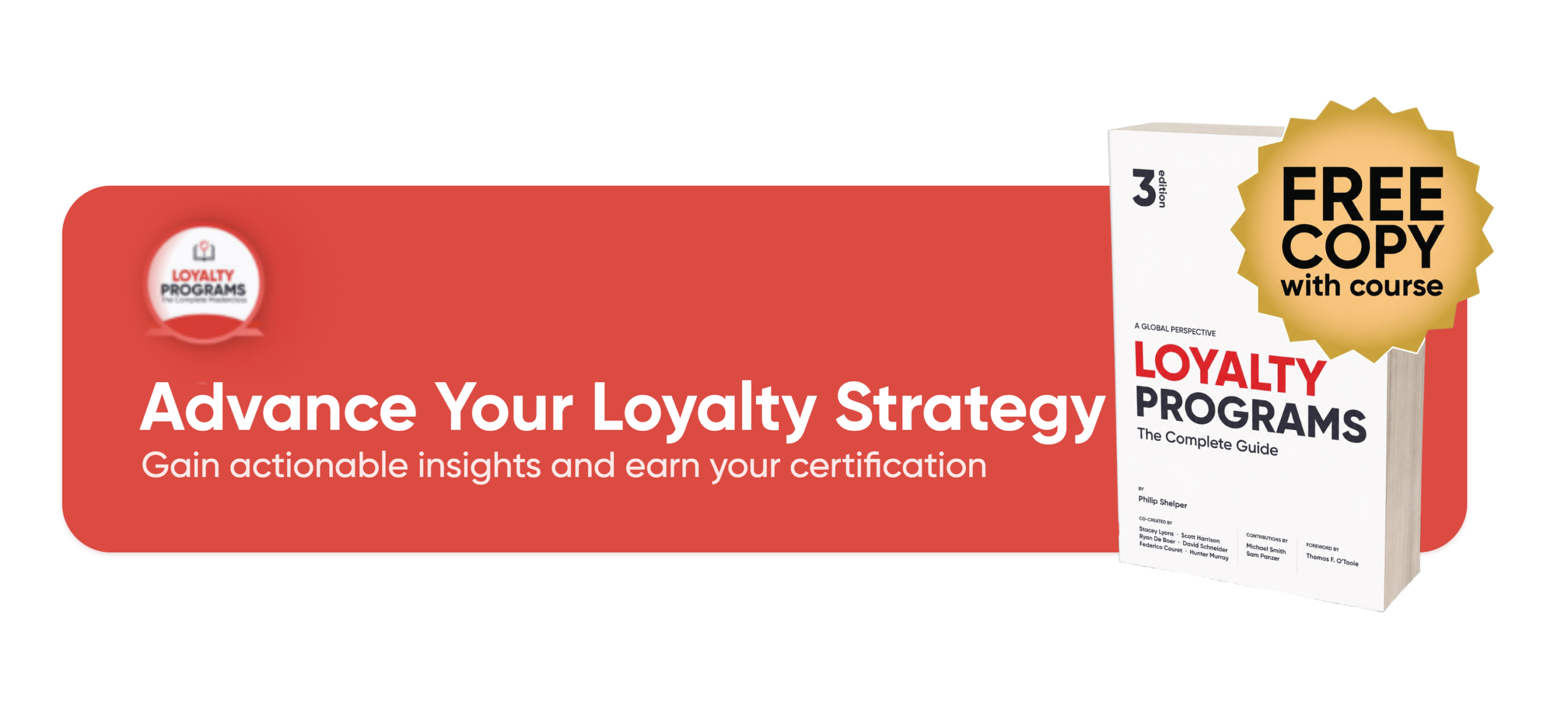
I was fortunate enough to co-write the subscription chapter of Loyalty Programs: The Complete Guide (3rd Edition). Writing chapter 9 meant analysing hundreds of subscription programs end to end. Earn mechanics, cadence rules, pricing tables, terms and conditions.
As loyalty consultants, when we are designing best-practice loyalty programs it is almost inevitable that our clients bring up Amazon Prime. The real interesting part is that the most successful paid membership on earth keeps insisting it is not a loyalty program.
Amazon has every commercial reason to claim the title. Prime has more than 200 million members across 27 countries. Instead Amazon refuses it, repeatedly, on the record, in the exact language a loyalty consultant would use. In September 2026 the worldwide head of Prime did it again from a conference stage in Nashville, and his reasoning turns on breakage, and it has direct consequences for anyone charging a fee on a loyalty program.
A subscription is a recurring fee paid for ongoing access. A loyalty program is a structure that rewards members for behaviours the business wants to encourage. Chapter 9 of the book treats subscription as a mechanic applied to a loyalty program, not a category of program in its own right, which is why its sections read subscription combined with loyalty currencies, subscription combined with status tiers, and so on through all ten design components.
A paid loyalty program is what you get when the two are put together. The fee buys access to something, the program still rewards behaviour, and the two sets of economics have to coexist. Amazon’s argument is that Prime is only the first half of that.
Why does Amazon say Prime is not a loyalty program?
At Shoptalk Fall in Nashville on 29 September 2026, Jamil Ghani, Worldwide Head of Prime at Amazon, opened his keynote with a correction. Prime is a paid membership that earns trust through usage, rather than a loyalty program that rewards it after the fact.¹
He then named the two models Prime was designed against: gym memberships that go unused after January, and credit card points that expire before anyone redeems them. Prime’s economics, he said, are not built on breakage. A business that bets on customers failing to use what they have paid for builds fragility into its own revenue.
Amazon’s internal incentives run the other way. The more a member uses their benefits, the more value they take out, and the more valuable they become to Amazon. Ghani said a household that adds a second Prime benefit retains at a noticeably higher rate than one using a single benefit, and that a third and fourth benefit extend the effect. Prime now spans 35 categories, and Amazon measures the value it delivers at household level.
Greg Greeley made the same argument years earlier. He helped build the original Prime proposal, and has described the exercise he ran in 2003 with Andy Jassy and Jason Child to evaluate potential loyalty programs for Amazon. The data showed Amazon customers were already loyal, earned through selection, low prices, predictable delivery, and Super Saver Shipping. The six-page narrative that became Prime was titled Time Matters, and Greeley lists what it deliberately was not: not a points program, not a discount scheme, not a breakage model.²
Two people who built Prime have now made the same argument twenty-three years apart. For the structural difference between the two models, our breakdown of whether a subscription program is a loyalty program is the place to start.
What is breakage, and why does it fund most paid loyalty tiers?
Breakage is value a member has paid for, or earned, and never consumes. In a points program it is the unredeemed balance that eventually converts to margin. In a paid membership it is the benefit the member bought and never used.
The gym example Ghani reached for is one of the most studied findings in subscription economics, and almost every paid tier in the market is priced against it.
Lambrecht and Skiera (2006) documented flat-rate bias, the consistent consumer preference for flat-rate pricing even where pay-per-use would cost the member less. DellaVigna and Malmendier (2006) measured the gap it creates. Gym members in their study predicted around 9.5 visits a month and made about 4.2.
Members systematically overestimate how much they will use a subscription, and most fees are priced against that overestimate. Observed behaviour comes in lower, and the difference funds a large share of paid loyalty tiers, whether the operator has named it or not.
The same gap breaks programs in two opposite directions. Either the member notices it and cancels, or the benefit removes the cost of each additional use until the gap closes in the member’s favour and the economics collapse. Both happened over the past two years, to very different brands.
Case study: Why did Sweetgreen remove the paid tier from its loyalty program?
Sweetgreen launched Sweetpass nationally on 24 April 2023, after piloting it in January 2022. The program ran a free tier and a paid tier, Sweetpass+, at US$10 a month, giving members US$3 off a daily order alongside priority support, delivery perks, and early access to merchandise drops.³
In April 2025 Sweetgreen retired it and launched SG Rewards, a conventional points program earning 10 points per US dollar. The reason the company gave was that customers found the tiered subscription structure too complicated.⁴
On the Q2 2025 earnings call, CEO Jonathan Neman told investors the transition created roughly a 250 basis point headwind to second-quarter same-store sales, from deferred revenue recognition and a falloff among the small but high-frequency cohort of former Sweetpass+ members. By the Q4 2025 results, CFO Jamie McConnell was pointing to the transition as having eliminated subscription revenue outright.⁵
The paid tier was underperforming on acquisition and succeeding on retention at the same time. Casual customers could not parse the structure, and the fee asked them to commit before they could see any value. The members who did commit turned out to be the most frequent and most valuable customers Sweetgreen had. Removing it fixed the acquisition problem and cost Sweetgreen the retention asset at the same time. Almost every brand with an underperforming paid tier runs into that trade. Our piece on subscription apathy in DTC retail covers the related pattern, where subscriber counts hide two completely different customer types.
Case study: Ryanair Prime and what happens when the breakage never arrives
Ryanair failed in the opposite direction with Ryanair Prime, which launched in late March 2025 at €79 or £79 a year, offering free reserved seats, free travel insurance, and access to twelve member-only seat sales. Ryanair capped it at 250,000 members. It reached 55,000. The airline closed it to new sign-ups on 28 November 2025. Chief Marketing Officer Dara Brady said the scheme had generated more than €4.4 million in subscription fees while members had received more than €6 million in fare discounts.⁶
The pricing assumed a level of non-use that never materialised. Members used the benefits harder than the model allowed for, and the brand had no way to curb usage without a subscriber backlash. You can read our full analysis of Ryanair’s paid membership attempts, including the questions the headline figures leave unanswered here.
Case study: MyPanera and the Sip Club cap engineer breakage back in
Panera has taken a third route. It began with a coffee and tea subscription in February 2020 and broadened it into the Unlimited Sip Club in April 2022, covering all self-service drinks. On 13 July 2026 it updated the terms. From 19 August 2026 the program became MyPanera + Sip Club, with members limited to 30 beverage redemptions per billing cycle. The price held at US$14.99 a month or US$119.99 a year, and the word Unlimited came off the branding.⁷
The cap arrived as part of a larger change. On the same day Panera relaunched MyPanera nationwide as a points program earning 10 points per US dollar, structured in three tiers: MyPanera, free to join; MyPanera+, unlocked by spending US$300 in a calendar year; and MyPanera+ Sip Club, the paid subscription, which carries the MyPanera+ benefits plus the capped beverages. The subscription became the top tier of a loyalty program, with an earned tier directly beneath it.
The cap sets a floor under breakage, guaranteeing the operator a minimum unconsumed share of what the member paid for. That is the design Ghani says Amazon rejects. Capping costs less than closing and it protects the revenue line, though it changes a deal members had built a habit around and carries a reputational cost for doing so. Panera accepted that cost to keep a subscription that was heading towards Ryanair’s problem.
What should you ask before adding a subscription to your loyalty program?
I’ve written separately on the questions to ask before combining loyalty and subscription, covering demand, value, paywalling, and progression. The four below come from the research and case studies in chapter 9, and they decide whether the commercial model holds.
1. Which of your benefits depend on members not turning up?
Breakage reliance tracks the benefit type, not the fee. A benefit that costs the operator something every time it is consumed, such as a free seat or a free drink, needs most members to under-consume it. A benefit that pays out in proportion to spend, such as a currency multiplier or a cashback rate, works the other way, because the member only draws on it by transacting.
Nubank Ultravioleta pays 1.25 per cent cashback on all credit card spending, credited instantly, with no category restriction and no expiry. The program earns nothing from a member who leaves the card in a drawer. RH takes the principle further. It replaced its promotional sale events with a paid membership in March 2016, now priced at US$200 a year for 30 per cent off everything, and by the financial year ended 31 January 2026 members accounted for approximately 97 per cent of sales in its core business.⁸ Almost every member consumes the central benefit on almost every purchase, and the model holds.
Where a benefit does carry a consumption cost, model the heavy-user tail instead of the average member. Ryanair priced against a population-typical usage rate that the benefit itself destroyed, because removing the marginal cost of each additional use attracts the members who will use it most. Model the top decile and price for them, then check whether the model survives if they turn out to be five per cent of the base instead of one.
2. Are you funding the part of the lift that does not need funding?
Iyengar, Park, and Yu (2022) studied a beauty retailer in Asia that launched a US$50 annual subscription, matching more than ten thousand subscribers against a comparable sample of non-members. Subscribing lifted spend by US$27.45 per member per month from a baseline near US$12, so spend more than doubled.
Only about a third of that lift traced to the economic benefits the subscription delivered. The remaining US$17.91 survived controlling for every tangible benefit in the program, and the authors attribute it to the upfront fee creating a sunk cost that members then act to justify.
The finding should change how you size a paid tier. A program competing purely on calculable value overfunds the part the fee already buys, and it draws members who are already inclined to calculate their return and cancel.
3. Do your earned and paid status paths undermine each other?
Drèze and Nunes (2009) found that elite status loses perceived value as the elite population grows. Members who already hold a tier value it less when more people share it. Selling status therefore dilutes what long-tenured members earned through behaviour.
ALL Accor+ manages the problem by limiting what the fee buys. Subscribing credits the member with 30 bonus status nights, which confers ALL Gold immediately. Reaching Platinum requires 30 further status nights earned through actual stays. The subscription buys entry to the hierarchy without touching the tiers members reach through behaviour.
Panera’s new structure does the same thing in a different order, placing an earned tier at US$300 of annual spend immediately below the paid subscription so that frequent non-subscribers still have somewhere to progress to.
4. Can members see the break-even before they are charged?
Acquisition is harder than design in subscription, because the fee is visible at sign-up while the value only appears after use. Members who cannot calculate the break-even tend not to join. Members who calculate it and come up short have a precise reason to cancel.
Nubank Ultravioleta publishes the rule and applies it automatically, waiving the R$89 monthly fee in any month the member spends R$8,000 on the card or holds R$50,000 invested. Loyalty & Reward Co client MANSCAPED takes a different route with Members Only Rewards, keeping the currency open to every purchaser at 5 points per US dollar so a buyer accumulates Rewards Cash from their first transaction, with an earned middle tier at 8 points per US dollar after US$100 of annual spend and the VIP subscription at 10 points per US dollar, so the fee raises the earn rate instead of gating the currency.
Want to learn more about subscription and loyalty?
Chapter 9 of Loyalty Programs: The Complete Guide (3rd edition) covers the eight subscription types Loyalty & Reward Co have identified, the ten consumer motivations for subscribing, and how subscription combines with each of the loyalty design components, with case studies including RH, ALL Accor+, MANSCAPED, Nubank Ultravioleta, Peloton, Rapha Cycling Club, Butternut Box, and Zomato Gold.
Get the book here or if you would like to discuss how subscription and loyalty strategies can work together for your brand, get in touch.
Referencias
1. ClickZ, “Amazon Prime’s Vice President Says Loyalty Isn’t a Reward”, 1 October 2026, reporting Jamil Ghani’s keynote at Shoptalk Fall 2026, Music City Center, Nashville, 29 September 2026. clickz.com/amazon-primes-vice-president-says-loyalty-isnt-a-reward/273756/
2. Greg Greeley, personal account of the 2003 Amazon loyalty program review and the Time Matters proposal, published on LinkedIn, 2026.
3. Business Wire, “sweetgreen Launches Sweetpass”, 24 April 2023.
4. Restaurant Dive, “Sweetgreen abandons tiered loyalty for points-based program”, April 2025. restaurantdive.com/news/sweetgreen-points-based-sg-rewards-ripple-fries/744283/
5. Restaurant Business and Restaurant Dive reporting on Sweetgreen Q2 2025 and Q4 2025 earnings calls.
6. Skift, “Ryanair Scraps Prime Membership Program After Just 8 Months”, 28 November 2025. skift.com/2025/11/28/ryanair-scraps-prime-membership-program-after-just-8-months/
7. Panera Bread, “Panera Unveils All New Points-Based MyPanera Rewards Program”, PR Newswire, 19 August 2026
8. RH, Form 10-K for the financial year ended 31 January 2026, and Form 10-K for the financial year ended 3 February 2018, US Securities and Exchange Commission; RH, “RH Reimagines & Simplifies the Shopping Experience”, RH Investor Relations, 23 March 2016.
9. Lambrecht, A. & Skiera, B., (2006). “Paying too much and being happy about it”, Journal of Marketing Research, Vol. 43, No. 2, pp. 212-223.
10. DellaVigna, S. & Malmendier, U., (2006). “Paying not to go to the gym”, American Economic Review, Vol. 96, No. 3, pp. 694-719.
11. Iyengar, R., Park, Y.-H. & Yu, Q., (2022). “The impact of subscription programs on customer purchases”, Journal of Marketing Research, Vol. 59, No. 6, pp. 1101-1119.
12. Drèze, X. & Nunes, J. C., (2009). “Feeling superior: the impact of loyalty program structure on consumers’ perceptions of status”, Journal of Consumer Research, Vol. 35, No. 6, pp. 890-905.