Loyalty programs typically depend on people. A member shows a card, opens an app, checks a balance, and decides when to redeem, while staff at the counter, the gate, or the front desk provide rewards and recognition. Over the next decade, machines with a physical presence start taking on some of the delivery, including utility, zoomorphic and humanoid robots, as well as drones.
While this idea seemed fanciiful a few years ago, social media feeds are now full of a new wave of robot innovations, while the horrible war in Ukraine has fast-tracked astonishing advances in drone technology.
Robots will affect loyalty in two very different ways. In service settings, a robot can make recognition more visible and more personal than any app has managed. In the home, a robot can take the member out of the purchase decision entirely. Program operators need a plan for both.
The humanoid concierge
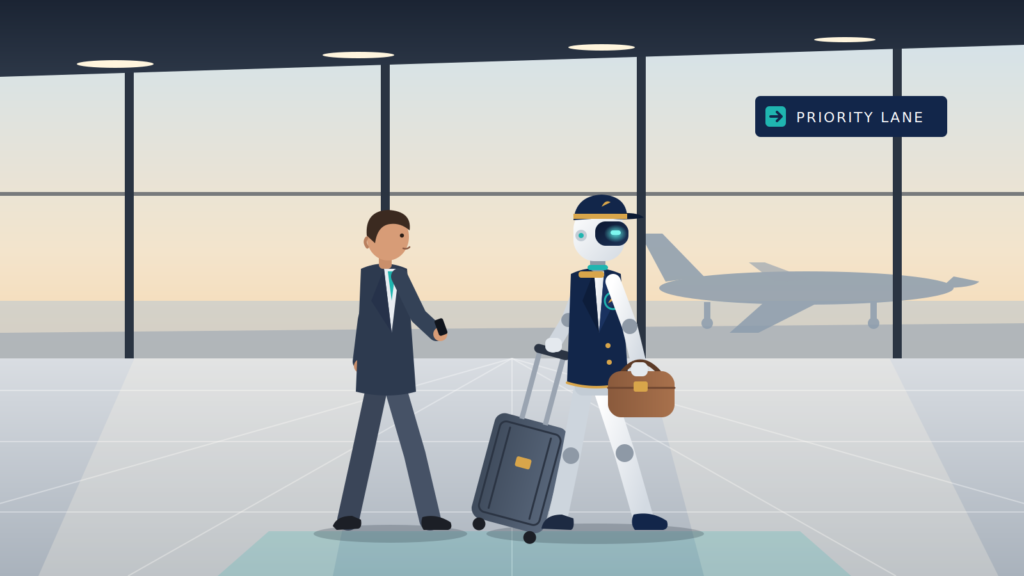
Picture a top-tier frequent flyer pulling into the airport car park. Their personal agent communicates to the airline they are about to arrive, and by the time they park, a humanoid robot in the airline’s uniform is waiting. It greets them by name and takes their bags. It completes check-in as it walks beside them, leads them to a fast-track security lane that opens on a biometric scan, and shows them to a table already set aside in the lounge with their preferred drink.2
The robot can do more along the way. It might take a meal order for the flight, play a short game that awards bonus points, or ask the member to confirm a seat or dietary preference so the airline’s data stays accurate. For the member, recognition becomes something they can see and feel. For everyone else in the terminal, the robot becomes a visible status symbol, in the same way a priority lane or a lounge door has been for decades.
As things advance, the experience miay then flip. If robots become the standard service layer, mid-tier members may be the ones who request a robot, while top-tier members receive the scarcer privilege of a human chaperone.2 Program designers will need to decide which of these two futures fits their brand, and test it with members before committing capital.
Robots and drones in hotels and stores
Hotels and stores could use robots in similar ways. A hotel robot could greet a returning guest in the lobby, already aware that their last stay ended with a complaint, and offer a resolution and bonus points before the guest has to raise it. A store robot could recognise a high-value member who has agreed to facial recognition, fetch the items they saved online that morning, and bring them to the fitting room. When a member reaches a milestone, a drone could arrive at their door with a gift and a message that uses their name (in a way that isn’t creepy).3
Surprise and delight, a loyalty program design component that is incredibly powerful in generating emotional connections between brand and member, can often rely on a staff member noticing a moment and acting on it. A robot working within rules the brand has approved can catch every eligible moment. Service recovery could change in the same way, with a member’s problem handled by a patient helper standing in front of them instead of a phone queue or a chat window.3
Drone delivery is already part of a paid membership in the United States. Walmart and Alphabet-owned Wing announced in January 2026 that drone delivery would expand to 150 more Walmart stores during the year, on the way to more than 270 locations by 2027. Wing reported that its top 25 per cent of customers in Dallas order about three times a week. According to Supermarket News, the service is free for Walmart+ members and costs US$19.99 per delivery for everyone else, which makes the drone itself a membership benefit.
Inside the store, robots and drones may handle much of the service load. A scanning drone could circle a member for a few seconds before they try anything on and record precise body measurements, so the garment waiting in the fitting room fits the first time. That profile can sit in the member’s program record and shape future recommendations. Many stores will evolve into flagships and carry very little stock, with purchases dispatched by drone from a central warehouse within the hour or even manufactured to the member’s measurements on demand. Earn, redemption, and payment can then settle as the member walks out, with their identity as the credential. Robots and drone promise clienteling for the masses.4
Why physical recognition builds attachment
Being greeted by name, served without having to ask, and singled out for care in front of other people are some of the oldest signals of status and belonging. An email offer or push notification, however well timed, arrives alone on a phone, while a robot that meets a member at the kerb is seen by everyone nearby.
Belonging, status, identity, and reciprocity drive attitudinal commitment, the emotional attachment that keeps members loyal when a competitor offers a better price. Embodied robots could be the first technology able to act on all four at once, in the physical world and at the moment of service.5 A member attended by a branded robot is likely to feel a stronger connection than one who receives a well-timed push notification, and the brands that learn to deliver this early will enjoy a valuable strategic advantage.
Of course, mistakes will be just as visible. A robot that greets a member by the wrong name, offers a product they returned last week, or recognises them after they asked not to be recognised does damage in a public setting.6
Humanoid robots in 2026, and two early failures
Consumer humanoids are now on sale, at least to early adopters. In October 2025, 1X Technologies opened pre-orders for its NEO home robot at US$20,000, or US$499 a month on subscription, with US deliveries scheduled for 2026. Early units mix autonomy with remote human operators who take over tasks the robot cannot yet manage, a design that has already raised privacy concerns about cameras moving around people’s homes.
Hotels and retailers have tried robot service before, with poor results. Japan’s Henn na Hotel opened in 2015 with a mostly robotic staff and, in 2019, cut more than half of its 243 robots. Guests found them annoying, they broke down often, and human staff ended up working overtime to fix them. In-room assistants mistook snoring for voice commands and woke guests during the night.
SoftBank’s Pepper, a humanoid greeter that appeared in phone stores and restaurants, followed a similar path. Production stopped in 2020 after roughly 27,000 units, with IEEE Spectrum reporting that the robot could attract attention and share information but could do little useful work with its hands.
A robot has to do something the member values, reliably, before it can strengthen the relationship. Novelty will likely wear off within a few visits, and a robot that fails in front of a member damages the brand that put it there. Pilots should measure task completion, member satisfaction, and staff workload from the first week, and keep a human close by for every recognition moment until the robot proves it can handle them.
Household robots and the loss of conscious choice
A robot that restocks the kitchen is a buyer as well as a helper. When it notices the coffee running low and orders more, the member does not stand in an aisle comparing brands. The brand gets chosen, delivered, and shelved without anyone in the household thinking about it.7
Most loyalty psychology assumes a person is present at the moment of choice. Habits form through rewarded repetition. A sense that a brand is “me” grows through repeated conscious choice. Endowed progress, the pull of a goal that is partly complete, works only if the member sees their progress, and psychological ownership, the sense that a brand is “mine”, depends on feelings of control and personal investment.8
A household robot can lift behavioural loyalty while weakening attitudinal loyalty. Repeat purchase may rise, because the robot keeps reordering. Emotional attachment may fall, because the member no longer makes the choice. The brand becomes a setting in someone’s automation, kept until a cheaper or better-documented option replaces it, at which point the robot switches and the member may never notice. Marketing scholar George Day warned in 1969 that repeat purchase on its own is a weak measure of loyalty, and household robots could make his warning far more costly for brands (Day, 1969).8
Members will probably hand routine categories to their robots and keep making their own choices in categories they care about, such as wine, fashion, or travel. Program operators can design for that split. In categories the robot buys, the priority is to be the default the member sets and to stay competitive enough that the robot has no reason to switch. In categories the member still chooses, the program can protect the moments of conscious choice, visible progress, and recognition that build attachment. This is not just limited to robots but extends to AI shopping agents, and is one of the major challenges loyalty program operators will face over the next decade.
Robots as customers
Some robots will buy for themselves, with no person involved in the decision. Gartner calls these machine customers, or “custobots”, and defines them as non-human economic actors that can negotiate and purchase goods and services on their own in exchange for payment. Gartner forecasts 15 billion connected products with the potential to act as customers by 2028.
Early versions already sit in homes and offices. A printer enrolled in HP Instant Ink tracks its own ink levels and orders a replacement cartridge before the owner notices it is running low. HP builds the printer and also sets the printer’s buying rules, so retention is designed into the product and no points are needed.
By the early 2030s, delivery fleets may book their own charging slots, cleaning and warehouse robots may order their own parts and consumables, and robot fleets may choose between suppliers thousands of times a day.9 These buyers feel no sense of belonging and cannot be moved by a gamified challenge. They compare price, reliability, availability, and how easily they can connect to a supplier’s systems.
For a charging network, parts supplier, or maintenance business, this creates a new kind of business-to-business (B2B) loyalty program. The benefits that win a robot customer are volume pricing, guaranteed availability, service-level commitments, and value published in a format a machine can read and verify. Brands that start designing for robot customers now will be early into a market that could grow larger than many of their human segments.
Privacy and consent for robots that see and remember
Every robot described above collects data people may consider intimate, including faces, body measurements, where a member walks in a store, how long they look at a product, their expression, and what happens inside their home. Some members will enjoy a store that knows them, while others will find it unsettling. The same member may even feel differently on different days.6
Recognition therefore needs to be something the member grants and can withdraw at any time. A member could let their personal agent send a short brief as they approach a store, covering sizes, preferences, dietary needs, and whether they want full recognition or a quiet browse. A member who chooses anonymity on a given visit should find that the store, and its robots, forget them at the door.10
European law already restricts usage of this kind of data and more regulators globally will follow. The European Union’s General Data Protection Regulation (GDPR) treats biometric data used to identify a person as a special category that needs explicit consent or another narrow legal basis. A program that uses facial recognition or body scans for robot recognition will need consent records, clear opt-outs, and data retention rules designed in from the start.
Practical steps for program operators
Robot service at scale will take years, and timelines will vary by industry and market. Large capital commitments made now carry real risk. The data, consent, and design work that robots depend on can start today, and it should pay back through better personalisation even if the robots arrive late.11
Foundaitonal steps brands can take now include:
- Unify member identity across app, website, store, and service channels, so a robot, drone, or associate can recognise the same member wherever they appear
- Build a permission layer that lets members grant, limit, and withdraw recognition, including a simple anonymous mode
- Decide which moments stay human by mapping the member journey and marking where a person is most important, where a robot could add value, and where a robot could cause harm
- Run small, measured pilots in controlled settings such as a lounge, a flagship store, or a hotel lobby, with clear success measures and a human on hand
- Treat the robot as a benefit and test it in the tier structure, whether as a status reward for top members or as a standard service that frees staff for personal care
- Review household and machine buying in your categories, and decide how the program will stay the default when a robot does the ordering
- Keep architecture open so robot, drone, and spatial interfaces can plug into the program’s data and rules when member demand and the technology are ready
And most of all, be nice to your robots, becuase you never know . . .
The human member remains the person whose trust and permission decide whether any of this works. Robots can extend recognition to far more members than staff alone can reach, provided the program earns the right to use them.
Loyalty & Reward Co are the world’s only pure-play loyalty consultancy based in new York, London, Dubai, Sydney and Melbourne. We help brands design, implement, and evolve loyalty programs, including preparing them for robots, AI agents, and agentic commerce.
Notes
- Shelper, P., 2026, Loyalty Programs: The Complete Guide (3rd Edition), Loyalty & Reward Co, Conclusion, pp. 681-682 and 689-690
- Shelper, P., 2026, Loyalty Programs: The Complete Guide (3rd Edition), Loyalty & Reward Co, Conclusion, p. 690
- Shelper, P., 2026, Loyalty Programs: The Complete Guide (3rd Edition), Loyalty & Reward Co, Conclusion, pp. 690-691
- Shelper, P., 2026, Loyalty Programs: The Complete Guide (3rd Edition), Loyalty & Reward Co, Conclusion, pp. 691-692
- Shelper, P., 2026, Loyalty Programs: The Complete Guide (3rd Edition), Loyalty & Reward Co, Conclusion, p. 691, drawing on the drivers of attitudinal commitment set out in Chapter 5
- Shelper, P., 2026, Loyalty Programs: The Complete Guide (3rd Edition), Loyalty & Reward Co, Conclusion, p. 692
- Shelper, P., 2026, Loyalty Programs: The Complete Guide (3rd Edition), Loyalty & Reward Co, Conclusion, p. 691
- Shelper, P., 2026, Loyalty Programs: The Complete Guide (3rd Edition), Loyalty & Reward Co, Conclusion, p. 689; Day, G. S., 1969, ‘A Two-Dimensional Concept of Brand Loyalty’, Journal of Advertising Research, Vol. 9, No. 3, pp. 29-35
- Shelper, P., 2026, Loyalty Programs: The Complete Guide (3rd Edition), Loyalty & Reward Co, Conclusion, p. 688
- Shelper, P., 2026, Loyalty Programs: The Complete Guide (3rd Edition), Loyalty & Reward Co, Conclusion, p. 691
- Shelper, P., 2026, Loyalty Programs: The Complete Guide (3rd Edition), Loyalty & Reward Co, Conclusion, p. 698