AI and loyalty have primarily been discussed from the operator or brand’s side: better targeting, smarter offers, faster operations. This is where a lot of the activity still sits, but customers are now starting to use AI agents of their own, and when an agent does the choosing, it raises a bigger question for brands and their loyalty programs… who owns the relationship? And if agents take away the effort and habit that keep many members coming back, how much of that loyalty would survive?
How Are Brands Using AI in Loyalty?
Brands are already using AI in many ways, much of it behind the scenes on everyday operational tasks. Loyalty is no exception. In Loyalty360’s 2026 survey of more than 160 brand marketers, the most common uses of AI in loyalty were content creation and messaging (43%), segmentation and personalisation (40%), while predictive analytics (27%) and customer service automation (25%) were less common.
What this shows is that practitioners are mostly using AI to create content and personalise better, and less so for full automation and execution, particularly where that relies heavily on trusted data, such as offer optimisation (which is only 20% of respondents).
Examples of brands using AI in loyalty
What does this look like? Here are two current brand examples:
- Tesco’s Clubcard Challenges use Eagle Eye’s AI to set each member their own spending goals, based on their shopping habits and worth 50 to 500 bonus points each. One member might be asked to spend £20 on the summer barbecue range over six weeks, while another is asked to spend £10 on plant-based ready meals. Tesco has offered them to up to 7 million customers. Personalised offers aren’t new, but AI makes it far easier to individually tailor them to millions of people at scale and to test what works.
- Bank of America’s Erica is interesting in relation to customer service operations. Chatbots are currently one of the most common use cases by businesses, but are often set up to be reactive: you have a question or a problem, and they answer it. Erica is increasingly proactive. Bank of America says it has delivered more than 1.7 billion proactive insights, including reminding clients about cash back offers they can use and telling them when they qualify for Preferred Rewards. That shift from answering to prompting matters, and I expect to see much more of it as AI becomes more agentic.
How Are Customers Using Agentic AI?
Industry examples like these are where the focus has been, but customers are using AI too. Much of this shift comes from personal agents reaching the mainstream: Instinct, OpenAI’s Dots and Meta’s Muse, which Meta has promoted heavily since its launch. Alongside them, shopping tools are now built into ChatGPT and Google’s AI Mode. Together, they let customers send AI to deal with brands on their behalf. It is still nascent, but things are shifting for some.
Think about the small but frustrating tasks that all of us as customers face: sit on hold, ask for a better bill based on our loyalty, chase a refund, cancel a service, coordinate a booking or check which offers and promotions we can use before we shop. Some people say they are now handing tasks like these to AI, to varying degrees, with posts on X claiming hundreds of dollars saved on phone and internet bills, and Forbes reporting on people using agents to chase refunds and cancel subscriptions. That said, the results are uneven. WIRED describes an agent that saved $550 but made a $64 mistake, and a Business Insider reporter’s agent failing to lower her internet bill. These are fairly simple tasks, but they got me thinking: what might dealing with brands look like if customers started handing more of it over to AI?
Three levels of agency
It may help to think of this through three levels of agency in using these tools:
- Research and choose: AI finds and compares information or options, and the person decides
- Authorise: AI recommends and prepares an action, and the person approves it
- Execute: AI acts on the person’s behalf, within limits they have set (or perhaps no limits)
Most people are still using AI to research. Bill negotiations and refund chasing are early signs of the shift towards execution, and the same person may draw different lines for different types of decisions.
Take a member planning a weekend away. At the research level, they might ask AI to compare hotel prices, member rates and the value of using their points (or other loyalty benefits). The authorise level, the agent could recommend the best option and prepare the booking for approval. At the execute level, the member could simply give their agent a budget and a set of preferences, and leave it to make the booking.
Customers have new tools for pursuing value and convenience, and brands will need to decide how they respond. Some already have, and they are not all making the same call.
Who Owns the Relationship When an Agent Does the Choosing?
In September 2026, less than two weeks after Meta launched Muse, Amazon blocked Meta’s Muse agent from Amazon.com. Its stated reasons were primarily about conduct, with Amazon saying the agent didn’t identify itself and appeared to collect login details (which Meta disputes). But Amazon also mentioned that agents bypass the personalisation built into its store. (Note: Muse wasn’t the first agent it had kept out. It had already restricted shopping agents from OpenAI and Google.)
The personalisation point is the one to watch. Personalised recommendations, and the ads that sit around them, are a very lucrative business. Amazon’s advertising revenue passed $68 billion in 2025. But that only works if the customer comes to Amazon to browse and choose. If the customer asks an agent instead, and the agent brings back a shortlist (whether via Amazon or other sources), the agent (or the underlying owner of the model) is now potentially the one holding the relationship. It gets the data, the attention and potentially the influence over the decision.
Other companies are making the opposite bet. Within days of the block, Shopify opened checkout to Muse across every store on its platform through Shop Pay, and brands like Walmart, Sephora and Expedia were announced as Muse partners.
That leaves every brand with a real choice. Amazon is protecting its place as the destination. Other brands, by contrast, are choosing reach, treating agents as another discovery channel to show up in, much like the store, mail, phone, email, apps and third-party ad platforms before them.
Will the walled gardens just move?
It also brings to mind the concept of the walled gardens (big platforms that keep their users, and the data about them, inside their own ecosystem, giving brands access but not ownership). Brands already put their data into Google and Meta to run ads, and get impressions, potential conversions, and some reporting back. But they do not necessarily own that information. If the same platform (whether it be Anthropic, OpenAI, Meta, or another platform) starts to handle discovery, comparison and purchase, it could own more of the funnel than any marketplace has.
We could get to a point where customers begin more of their shopping journeys via an agent, rather than with a brand. Whereby, the agentic tool of preference becomes the primary interface through which they discover, compare and buy. None of this will happen overnight, and it’s hard to say at what pace the way people shop will change, if at all. Consider how online banking, shopping and payments (trusting an online website with credit card information) took the best part of a generation to become completely normalised. But whoever the customer asks to do the choosing is best placed to influence the decision, and with it, own more of the relationship.
Why Loyalty Becomes More Important
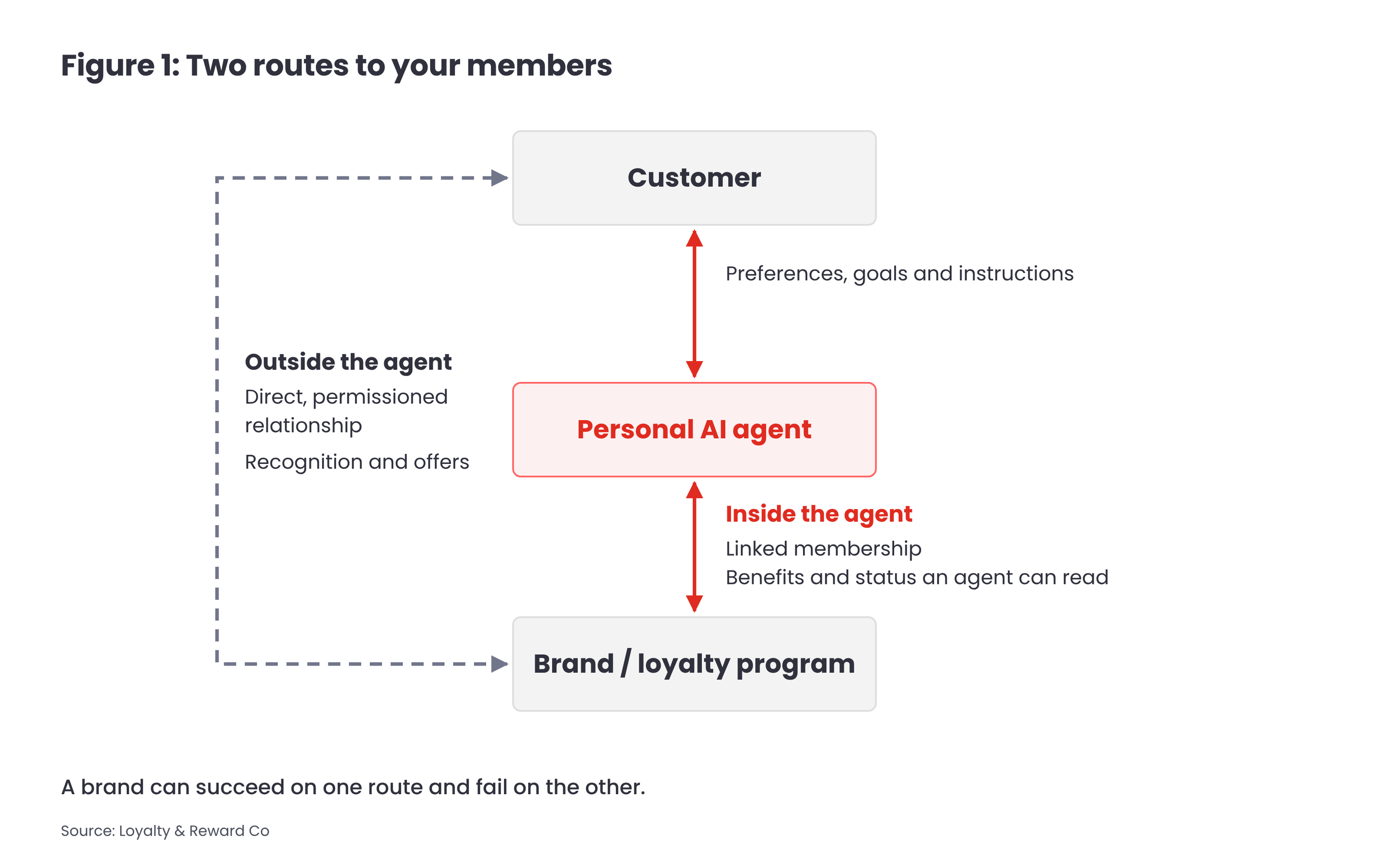
Outside the agent
If an agent sits between you and the customer, you need another way to reach them. That is where some form of membership or loyalty program comes in. It is an identified, permissioned relationship: a way to recognise customers, talk to them and influence what they do. A brand which continues to rely on an email newsletter alone will find that connection getting thinner, especially as more inboxes are summarised and prioritised by AI. An active program, with offers and recognition members respond to, gives a brand more ways to stay in the picture.
Inside the agent
Customers will set agents up around their own goals. A deal-lover will ask for the best price. Others will ask the agent to balance value and quality with the brands and memberships they care about. So, the question for a brand is whether it is part of that instruction.
Already happening. Some brands are already moving there. Target Circle members can link their accounts in Google’s AI Mode and Gemini, Microsoft Copilot and ChatGPT, and in Copilot their member discounts and free shipping apply at checkout. Target says traffic from AI platforms is growing more than 3.5 times faster than the industry average. Sephora has launched its own app inside ChatGPT, where Beauty Insider members get recommendations from their profile and can use their rewards, while also signing up as a Muse partner.
The plumbing. The Google-backed Universal Commerce Protocol (UCP) added a loyalty extension in August 2026, with Google publishing its implementation guides in October. Once a member account is linked, retailers can recognise membership and status, apply member pricing and benefits, and show how many points could be earned on a purchase. Noting, this currently only supports loyalty at checkout, with personalised search results planned for a future release, and it doesn’t yet cover points balances or redemption.
What Kind of Loyalty Survives an Agent?
There is a catch, though. Loyalty only works as a moat if the value holds up when an agent compares it with everything else.
This is where the distinction between behavioural and attitudinal commitment matters. People often keep buying because they’re used to something or there’s no better alternative (behavioural commitment), not because they actually prefer it (attitudinal commitment), and brands often confuse the two. (We see this frequently in our own consulting work with clients, and predict it will become increasingly important for brands to work for both.)
Why points and status feel bigger than they are
This matters because so many of our daily decisions run on heuristics and biases. For example, in the context of an airline loyalty program, loss aversion makes giving up status or a points balance feel bigger than it is. Sunk cost in flying with that same airline (and retaining a specific status) makes the years already invested feel like a reason to stay. It’s why some frequent flyers book a “mileage run”, a trip taken purely to keep their status. The status matters to them, but often more than its actual value would justify.
An agent doesn’t feel loss aversion or sunk cost (at least not in the way a top-tier flyer might). It can simply do the maths: if I gave up this status and these points and switched, would I be better off in three months with a different airline or a different credit card? For loyalty, that is a whole new game.
Many loyalty programs are designed, at least in part, to build habit and to get members investing their time, effort and money: earning towards the next tier, building up a points balance, beating an expiry date. The more effort members put in, the more invested they feel, and that is what gives loss aversion and sunk cost their pull. An agent could take on much of that effort, tracking, comparing and earning on the member’s behalf. This does not make loyalty mechanics like points or status worthless. A balance still has real value, and a member can still tell their agent that their tier matters. But the psychological attachment which comes from personally investing time and effort to earn them may be weaker.
When the friction goes
We’ve seen what happens when some of this friction is removed. When number portability and comparison sites made switching easier in telecommunications, energy and insurance, loyalty built on inertia (where it’s easier to stay than to explore alternatives or switch) weakened. People’s preference did not necessarily change; the friction went. So, in a more agentic future, behavioural commitment built on inertia is likely to be harder to build and easier to lose.
But agents could also strengthen behavioural commitment. An agent that tracks status, activates offers and prevents points expiring could concentrate a member’s spending with one program more effectively than the member could themselves. The distinction is between loyalty sustained by genuine economic advantage and loyalty sustained by inertia and complexity. Attitudinal commitment, genuine preference for a brand, can carry through: it could be handed to the agent as an instruction, such as “find good value, but stick with the brands I like.” Loyalty grounded in genuine value or genuine preference matters more than ever.
What Could Change for Loyalty Programs?
I see three broad areas where this could change how programs work.
Easier comparison will expose weak value. When an agent can compare every option in seconds, weak value becomes obvious and genuine preference counts for more, but only if the agent can understand what it’s comparing. If your benefits aren’t in a form it can read (or access), it may recommend alternatives without ever weighing yours.
Easier benefit use could increase both member value and reward cost. Most program economics assume not everything gets used: many points programs model breakage of 10% to 20% (though it varies by program type, industry and design), and the same applies to the utilisation (i.e., redemption) of other rewards and benefits. An agent that tracks balances, expiry dates and unused benefits could change that. Members would get more value more often, and even less engaged members may start using what they’re entitled to. That’s good for members, but costs go up, and the gap between your best members and the rest may look very different from the business case.
Fewer direct visits may change what engagement metrics tell us. If more of the shopping happens through an agent, members may visit your site and app less, and those visits will say less about how engaged they really are. This could cut both ways. An agent may pass back more specific signals, such as what a member asked for and why they chose you. Or, if the walled gardens grow, brands may see even less. Either way, identity becomes a more critical asset: knowing who your members are, with their permission to recognise them, wherever and however they shop.
What Makes You Worth Choosing?
Many brands ask us what they should be doing to adapt to this new agentic landscape. Here are four areas to consider right now:
- Look beyond how your own business (and industry) is using AI and understand how customers are using agents, what they’re asking them to do and how this could change their behaviour
- Structure your program (and broader customer) data (benefits, promotions, rules, status, balances) so agents can read it, even before the tools reach your market
- Consider how your technology architecture could support agents acting on behalf of members, including what data they can access, what actions they can take and what requires member approval
- Find out what really keeps members with you, such as habit and switching costs, or value they’d choose anyway, and invest in the second
Underneath all of this, the fundamentals stay the same: meaningful value, reliable data across the business, an accessible experience across every channel for members and their agents, and sound economics.
No matter who owns the funnel, maintaining a direct relationship with customers will still matter. You want to be the brand they ask their agent for by name. The question stays the same: what makes you worth choosing?
Getting Your Loyalty Program Ready for AI Agents
Loyalty & Reward Co can help you test whether your program’s value holds up when members, or their agents, compare every option. We can also help get your program’s data, rules and economics ready for agents, whether they take off next year or in five. Talk to our team.