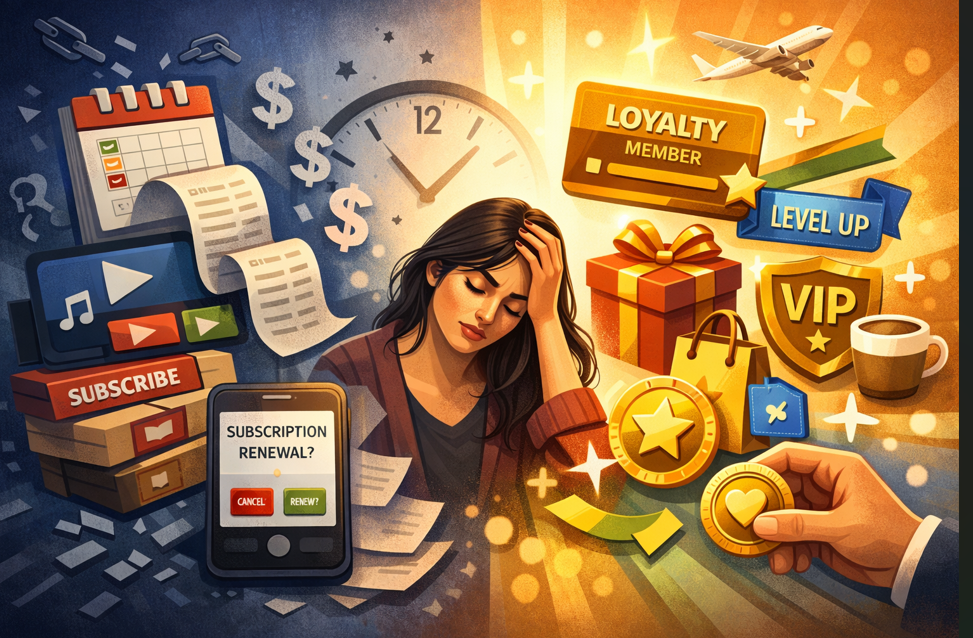
The subscription economy is booming. Consumer patience is not. Here’s what brands need to consider before layering loyalty and subscriptions together.
On paper, the subscription model is still thriving. The global subscription economy is on track to grow by 67% and surpass $1.2 trillion by 20301. The average US consumer spends at least $273 a month on 12 paid subscriptions2.
But underneath the growth numbers, a very different story is playing out at the consumer level. Let’s take streaming services as an example…
- In a 2025 study by Civic Science3, 41% of consumers said they have cancelled a streaming service because of subscription fatigue.
- Another 2025 study by Self Financial found that the average U.S. household has cut their subscriptions from 4.1 services to 2.8 in a single year, a 32% drop4.
- EY’s 2025 Decoding the Digital Home study found that 39% of streaming subscribers deliberately follow a “subscribe-watch-cancel-repeat” cycle. They sign up, binge a specific show, and cancel the moment they finish.
I see this behaviour everywhere. In conversations with friends, family, and colleagues, the pattern is the same: subscribe for a month, devour the content, cancel before the next billing cycle. There’s no penalty for leaving. There’s also no reason to stay. And in many cases, the streaming service will actually reward them for cancelling by sending a discounted winback offer a few weeks later.
This is the challenge facing every brand operating in the subscription space right now. Consumers have learned to game the system, turning a model built on recurring revenue and long-term relationships into a short-term, transactional tool.
Subscription fatigue is not just a streaming problem
While streaming services are the most visible example, subscription fatigue extends far beyond entertainment. Consumers are managing recurring payments across software, fitness, meal kits, beauty boxes, news, gaming, and more. The cumulative weight of all those monthly charges creates what psychologists call the Paradox of Choice where too many options leads to anxiety, decision paralysis, and ultimately, cancellations.
Regulatory pressure is mounting too. Governments and consumer bodies are pushing for “click-to-cancel” rules that make it as easy to leave a subscription as it is to join one. Brands can no longer rely on friction and inertia to retain subscribers.
Consumers are becoming ruthless editors of their subscription portfolios. Only the services that deliver clear, ongoing, differentiated value are surviving the cut.
My recent experience with Uber One got me reflecting on my own subscription fatigue. After years of Uber telling me I missed out on monthly savings and successfully dodging the sneaky sign-up they have baked into the checkout process, I finally took the plunge and signed up for a 6-month free trial.
The delivery fee on my take-out order was borderline extortion. So I did what any rational person would do. I signed up for the free trial, pocketed the $0 delivery fee, and gave myself six months to play with the program.
But…
Turns out my order didn’t qualify for the $0 delivery fee and before I could blink, the program was pushing me to upgrade to the annual plan. The offers, savings and benefits so far do not feel exclusive or enticing enough to warrant paying for a subscription. I have already diarised the 5-month mark so I can cancel.
Why brands are looking to merge loyalty and subscriptions
This environment is exactly why so many of the brands I work with at Loyalty & Reward Co are exploring the intersection of loyalty and subscriptions.
They tend to fall into one of two camps:
- Camp 1: “We have a loyalty program and want to add a subscription layer.” These brands already have an engaged member base and a functioning loyalty program. They see a subscription as a way to generate predictable recurring revenue, deepen engagement with their most valuable customers, and fund premium benefits that the loyalty program alone can’t sustain.
- Camp 2: “We have a subscription service and want to add a loyalty layer.” These brands have the recurring revenue but are battling churn. They want to give subscribers a reason to stay beyond the core product or content, to build exit barriers, recognise tenure, and create emotional connection that makes cancelling feel like a loss rather than a relief.
As loyalty consultants we’ve seen both approaches work brilliantly. We’ve also seen them fail spectacularly if the fundamentals aren’t right.
What to consider if you’re adding a subscription to your loyalty program
If you’re in Camp 1, here are the critical questions to ask before bolting a subscription onto your existing loyalty program.
- Is there genuine demand, or are you solving a problem that doesn’t exist? Not every loyalty program needs a paid tier. If your free program is delivering strong engagement and your members aren’t asking for more, forcing a subscription may alienate rather than elevate.
- Can you deliver enough value to justify the fee? Subscription fatigue means your members are already scrutinising every recurring charge. Your paid tier must make members feel the value from day one, deliver it consistently, and clearly outperform the free experience. If the value proposition is marginal, members will subscribe, assess, and cancel within the first 90 days. This is exactly where 44% of subscription cancellations occur5.
- Are you funding premium benefits or just paywalling existing ones? Nothing erodes trust faster than taking benefits that members previously enjoyed for free and locking them behind a paywall. The subscription should add genuine new value. Things like exclusive access, enhanced earn rates, premium experiences, concierge-level service and not simply repackage what already existed.
- Have you built in progression and recognition? A subscription without loyalty mechanics is just a recurring payment. The most effective hybrid programs reward tenure and engagement within the subscription. Think streak bonuses for consecutive months subscribed, exclusive milestone rewards, and tiered benefits that improve the longer someone stays. This creates the exit barriers that pure subscriptions lack.
What to consider if you’re adding loyalty to your subscription service
If you’re in Camp 2, the stakes are arguably even higher. You already have subscribers paying you money every month. The question is how to make them want to keep paying.
- Are you rewarding loyalty, or just charging for access? Most subscription services provide the same experience to a member who joined yesterday and a member who has been with you for five years. That’s a problem. Loyalty mechanics like points, tiers, milestone rewards, member recognition, etc., give you the tools to differentiate the experience based on tenure and engagement. This makes long-standing subscribers feel valued in a way that a flat subscription fee never can.
- Can you break the binge-and-cancel cycle? The subscribe-binge-cancel behaviour is fundamentally a value timing problem. The subscriber gets what they came for immediately, and the brand has nothing left to pull them forward. There’s nothing pulling them forward into the next month. A loyalty layer can change this dynamic by creating future value. Mechanics like points accruing towards a reward, a status tier they’re close to unlocking, or an exclusive benefit tied to their next billing cycle. The goal is to make the answer to “should I cancel?” consistently “not yet.”
- Are you spending more chasing lapsed subscribers than rewarding loyal ones? If the discounted winback offer is your biggest investment in customer relationships, your model is broken. A loyalty program lets you redirect that budget towards rewarding the members who actually stay. Celebrating streaks, recognising milestones, and surprising loyal subscribers in ways that build emotional connection rather than training them to churn for a better deal.
- Does your data strategy support it? Subscription services typically sit on rich behavioural data like what content is consumed, how frequently, when, and for how long. A loyalty program gives you a framework to act on that data. Personalised challenges, curated recommendations tied to earn opportunities, and tailored rewards based on consumption patterns can transform passive subscribers into actively engaged members.
The bottom line: loyalty is the antidote to fatigue, not another symptom of it
Subscription fatigue is not going away. If anything, it’s accelerating. Consumers have more recurring payments than ever, more tools to track and cancel them, and less tolerance for services that don’t continuously earn their spend.
The brands that layer genuine loyalty mechanics on top of their subscription models or layer smart subscription economics on top of their loyalty programs are the ones that will build sustainable, long-term customer relationships in an increasingly transactional world.
The key word is genuine. A loyalty layer that’s just a points program bolted onto a subscription, or a subscription that’s just a paywall bolted onto a loyalty program, won’t cut it. The integration needs to be thoughtful, the value needs to be real, and the experience needs to reward the behaviours that matter most to both the business and the customer.
In a world where consumers are actively looking for reasons to cancel, give them a reason to stay.
To discuss how subscription and loyalty strategies can work together for your brand, get in touch.
Want to read more from us about subscriptions and loyalty programs?
- Read a compelling case for why streaming services in particular are leaving value on the table without a loyalty program: Do Subscription Streaming Services Need a Loyalty Program?
- For a deeper dive into how subscription programs differ structurally from loyalty programs, here is an excellent breakdown: Is a Subscription Program a Loyalty Program?