
The rewards and benefits of loyalty programs create value when they help members save money, make progress, simplify their lives, enjoy better experiences, or feel a stronger connection with a brand. Choosing the right rewards starts with understanding the types of value which matters with your members.
From experience, brands often begin reward planning by looking at program mechanics and components: points, cashback, a tier, etcetera. However, a clearer and more purposeful approach is to start with the member value. Starting with the desired behaviour and value gives program design decisions a clearer purpose. Two programs using the same mechanic can offer very different reasons to participate.
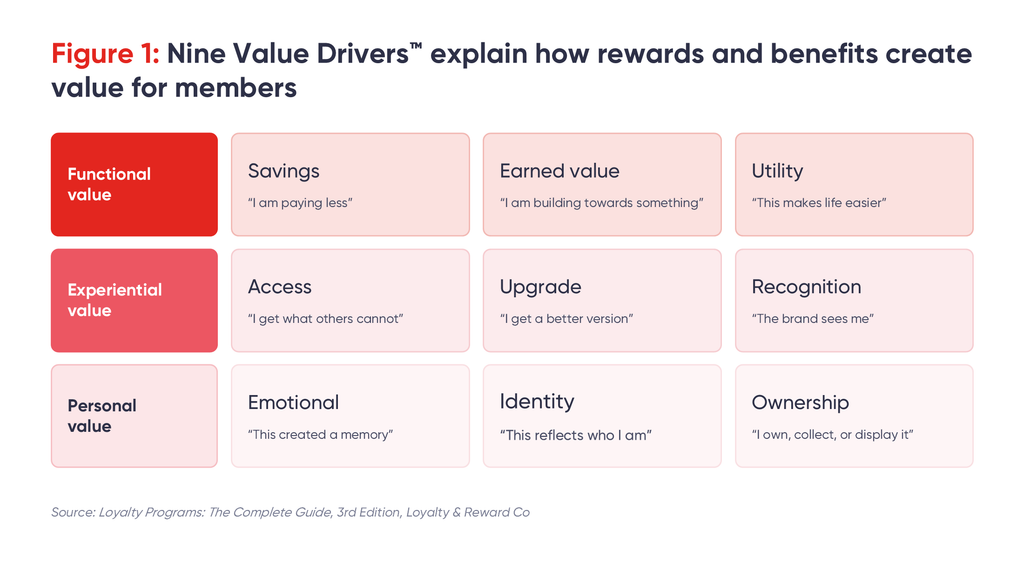
Loyalty & Reward Co’s Value Drivers™ framework, featured in the third edition of Loyalty Programs: The Complete Guide, identifies nine ways rewards and benefits can create member value. Teams can use it to brainstorm ideas, evaluate existing offers and reward mixes, and select the types of value that fit customers and business objectives.
What are the nine value drivers?
The framework groups the nine drivers into functional, experiential, and personal value.
Functional value is often practical value members can easily understand and calculate: savings, earned progress and utility. The member pays less, builds towards something, or finds that life becomes easier.
Experiential value changes what membership feel through the experience itself: access, upgrade and recognition. The member gets into something, receives a better version of the core service, or feels seen.
Personal value reaches into memory and self-image: emotional value, identity and ownership or collectability. The member forms a memory tied to the brand, feels participation reflects who they are or who they aspire to be, or offers something meaningful to own.
| Group | Driver | How it creates value | What the member feels |
|---|---|---|---|
| Functional | Savings | Reduces what the member pays (e.g., a discount) | “I am paying less” |
| Earned value | Builds progress towards a desirable outcome (e.g., points or stamps) | “My activity is building towards something” | |
| Utility | Saves time or reduces effort (e.g., free shipping or priority support) | “This makes my life easier” | |
| Experiential | Access | Opens up exclusive opportunities (e.g., lounge access) | “I can get something others cannot” |
| Upgrade | Improves a product or service experience (e.g., seat or room upgrade) | “I get a better version” | |
| Reconocimiento | Acknowledges the member’s relationship or contribution (e.g., status or priority) | “The brand sees and values me” | |
| Personal | Emotional | Creates a lasting memory or emotional association (e.g., surprise or experiences) | “This is something I will remember” |
| Identity | Reflects the member’s interests, values, or aspirations (e.g., community or co-creation) | “This reflects who I am” | |
| Ownership | Gives the member something meaningful to own, collect, complete, or display (e.g., collectibles) | “This feels like mine” |
Savings are often easy to explain and compare. Other drivers create value through convenience, progress, exclusivity, or personal meaning. Personal value can create a deep connection, but it is not equally available to every brand.
Research supports considering more than financial value. A meta-analysis by Liu-Thompkins et al. (2022), covering 319 studies into retailer loyalty, found that affective experiences were stronger drivers of loyalty overall than cognitive or social factors, although their relative importance varied across retail contexts. Loyalty & Reward Co discusses the research in Do Loyalty Programs Work? A review of scientific evidence.
This does not make one group of value drivers universally superior. The right combination depends on the member, the category, and the behaviour the program wants to influence.
These value driver categories are not a ladder, but diagnostic categories. A loyalty program does not need all nine drivers. The framework helps teams identify which kinds of value they deliver well, where their offer could improve, and whether another reward could create value more effectively.
A single reward can create several at the same time. A hotel room upgrade, for example, can be a better room, recognition of the guest’s status, access to a room they would not normally book, and a memorable part of the trip.
The practical question is: What kind of value is the loyalty program operator actually trying to create, and is there another way to create it more clearly, powerfully or efficiently?
Loyalty reward examples of the value drivers in practice
These examples bring each driver to life. Some draw on the broader brand experience, and a single reward or benefit can create several kinds of value.
Savings (Booking.com Genius): Member discounts on eligible stays give travellers a clear financial benefit: they pay less. The key risk here is that loyalty can become easily attached to the discount and is easy for competitors to match.
Earned value (Starbucks Rewards): Members accumulate Stars through purchases towards rewards such as a free drink, giving each purchase a sense of progress. Earning speed matters, as too slow an earn-to-redemption cycle could weaken motivation.
Utility (eBay Plus): Express-delivery upgrades and free returns on eligible purchases in Australia make shopping more convenient. This type of utility value can remove genuine customer friction and problems, though members may stop noticing it and overtime take it for granted.
Access (Zalando Plus): Its early-access launches have allowed members to shop selected limited collections before the wider customer base. Access must be genuine and reliably available to deliver value. An airport lounge that is routinely full, for example, turns a promised benefit into a frustrating wait, reducing its appeal and adding friction to the member experience.
Upgrade (National Emerald Club): At participating US and Canadian locations, Executive members can choose a full-size or larger vehicle from the Executive Area while paying the reserved midsize rate. This type of benefit can lose its shine and appeal when supply is saturated and everyone gets it.
Recognition (Mandarin Oriental Fans of M.O.): Member privileges and personalised touches acknowledge the guest’s relationship with the brand. Noting, attention alone can sometimes feel hollow, so this works best on top of practical or tangible value.
Emotional (Marriot Bonvoy Moments): members use points on one-of-a-kind experiences: concerts, sport, and dining with well-known chefs, often things money alone can’t easily buy. The brand becomes part of a memory the member will talk about for years. The caution is experiences can be hard to scale and don’t appeal to every member, so they work best on top of everyday value, not instead of it.
Identity (Gymshark): Fitness challenges and community events connect customers with others who share their interest in training. Notably, the same mechanics would feel artificial for a brand with no credible connection to that activity.
Ownership (LEGO Insiders): Members gain access to member-only gifts, limited edition collectibles, early access, and can build a digital history of their LEGO collection which they can share with other fans. This gives something meaningful to own, use, and display. The caution is fake scarcity and meaningless collectibles do not product personal value merely because the mechanics exist.
How to use value drivers to choose loyalty rewards
1. Define the behaviour you want to influence
Set a clear objective before generating reward ideas. It might be encouraging a second purchase, increasing visit frequency, or prompting category trial.
Be specific. “Increase engagement” gives a team less direction than “encourage occasional customers to make a second purchase within 90 days”.
Decide how you will measure success. Reward uptake is useful, but the commercial question is whether the offer generates additional behaviour at an acceptable cost.
2. Identify the value that matters to the member
Consider what would make the desired action worthwhile for your target audience.
Savings may appeal to a price-conscious shopper. Utility may matter more to someone short on time. A brand enthusiast may respond to exclusive access or a collectible they cannot buy elsewhere.
Use customer research and existing behaviour to guide the shortlist. Treat your choices as hypotheses to test: savings can support retention, and exclusive access can prompt an immediate purchase. Choose a small number of drivers that give the team a clear direction.
3. Generate ideas for each chosen driver
List what the business could offer under each selected driver. Include familiar rewards and less conventional possibilities.
Think beyond products and discounts. Faster service, staff expertise, participation in decisions, and acknowledgement of a milestone can all create value.
Build a broad list before narrowing it down. Ask whether each idea creates the intended value from the member’s perspective. A business should not force a specific value driver if it does not feel right for the brand and its customers.
4. Assess cost and delivery
Existing business assets can provide a useful starting point. Spare capacity, product upgrades, supplier-funded samples, and early access may create substantial member value at a relatively low incremental cost. These are efficient rewards: the member perceives them as worth materially more than they cost the business to deliver. Sometimes, the business is already offering meaningful value to customers, and could simply reframe the value under a loyalty program.
Include fulfilment, staff time, and any lost sales in the calculation. An upgrade using spare capacity has different economics from one that displaces a paying customer.
Our article on choosing efficient loyalty program rewards explores how to assess these opportunities.
5. Check the member experience and test the shortlist
A desirable reward can lose its appeal if members struggle to access it. Check how much effort, spending, waiting, or uncertainty the offer requires. Based on Vroom’s expectancy theory, from 1964. The idea is simple: people put in effort when they believe it will get them something they want. For a loyalty member, that comes down to three questions. Can I do it? Will I get it? Do I want it?
Can members realistically reach the reward? Are the rules easy to understand? Is redemption straightforward? Can the business deliver the benefit consistently?
Then review the overall mix. The dimensions described in 14 Types of Loyalty Program Rewards help assess choices such as immediate versus deferred and monetary versus non-monetary rewards.
Pilot the strongest ideas and measure their effect. Use the results to refine the offer before expanding it.
A coffee shop example: moving from ideas to a focused offer
A neighbourhood café could use the nine value drivers to generate the following ideas. The following example is illustrative, rather than a recommendation to use all nine.
| Driver | Reward or benefit idea |
|---|---|
| Savings | Member price on coffee during quieter afternoon hours |
| Earned value | A stamp card with a free coffee after ten qualifying visits |
| Utility | Order ahead with a dedicated pickup point |
| Access | Member tasting of the new seasonal menu |
| Upgrade | Complimentary extra shot or size upgrade |
| Reconocimiento | Acknowledge a member’s visit milestone with a personal thank-you |
| Emotional | A birthday treat with a thoughtful personal message |
| Identity | Members help choose a local cause the café supports |
| Ownership | A limited-edition cup earned through a seasonal challenge |
Suppose the objective is to increase afternoon visits among occasional customers. The café might shortlist two offers: an afternoon stamp card and a complimentary size upgrade during the same period.
The stamp card combines earned value, through progress towards a goal, with savings, through the free coffee. The size upgrade offers an immediate improvement to the member’s usual purchase.
Where practical, the café could test the offers separately against a comparable group receiving neither. It would track additional afternoon visits and contribution after reward costs, while checking whether customers simply moved existing morning visits to the afternoon.
The remaining ideas may suit other objectives. A seasonal tasting could encourage trial, while a collectible cup might appeal to regulars who already feel attached to the café.
Common questions about the value of loyalty program rewards
Does a loyalty program need all nine value drivers?
No. Select the drivers that fit your members, objectives, brand image and ability to deliver. A focused reward mix can create more value than a broad collection of benefits members rarely use.
Can one reward deliver several kinds of value?
Yes. A free coffee earned through a stamp card provides both progress and savings. An exclusive member experience might combine access, recognition, and emotional value.
Are low-cost rewards always efficient rewards?
No. Efficiency depends on the relationship between business cost and perceived member value. A reward that costs very little but has little appeal is unlikely to motivate members.
Value first, mechanic second
Understanding what makes loyalty program rewards valuable gives the design process a clearer brief. Teams can then select a suitable mechanic, assess the economics, and test whether members respond.
The strongest opportunities often come from matching what customers care about with what the business can credibly offer. Useful benefits, relevant experiences, and personal meaning can each give members a reason to participate.
The full Value Drivers™ framework, alongside reward economics and reward integrity, is covered in the third edition of Loyalty Programs: The Complete Guide.
Design rewards your members value
Loyalty & Reward Co can help you build a reward strategy that connects member value with your business objectives. Talk to our team.