Originally published in 2022. Updated in April 2026 to reflect that Aldi’s Pointless Points campaign is no longer running.

The supermarket sector in Australia is dominated by Woolworths and Coles with 37% and 28% market share respectively. They also dominate the Australian loyalty space with two of the most recognisable loyalty programs; Coles Flybuys and Woolworths Everyday Rewards.
There is little competition from other supermarket chains. If you think of IGA Rewards, the IGA loyalty card is not available in every store – only 20% of IGA stores participate in the loyalty program. Such a significant limitation makes it difficult to qualify it as a true loyalty program.
Now, if you are trying to remember whether Aldi has a rewards program, the short answer is no. They have done things in other ways. From a loyalty consulting perspective, it could be argued that they did in fact have a program, or rather, a customer engagement strategy. CEO of Loyalty & Reward Co, Philip Shelper, has mentioned this before with the idea of the Treasure Hunt strategy. Their strategy drove as much if not more loyalty as Coles and Woolworths’ reward programs has in proportion.
This underdog that rose from nothing to take two giants has won the hearts of many Australians in many ways. Although with a smaller 11% market share (up from just 4% in 2009), Aldi is the third preferred option for grocery shopping in the country and growing.
Since its arrival in 2001, Aldi has brought Australian consumers a greater choice over where to buy their everyday goods with quality products at low prices –always and for everyone. An attractive offer that rivals a duopoly that discounts products based on their shelving rosters and during campaign periods or to members only through their loyalty programs.
Aldi’s (not loyalty) loyalty program
Unlike other supermarkets, Aldi has super optimised their stores to offer lower prices, incurring little in operational costs. Unlocking trolleys with a $2 coin you retrieve on return, huge barcodes that are easy and super-fast to scan, products shelved in their original bulk boxes… or bring-your-own bags are a few visible examples that save them money.
And passing these savings to consumers works wonders for the business. Pick an Aldi catalogue from your nearest store and compare how much for a tub of yoghurt, milk, free-range eggs or bread. They are cheap.
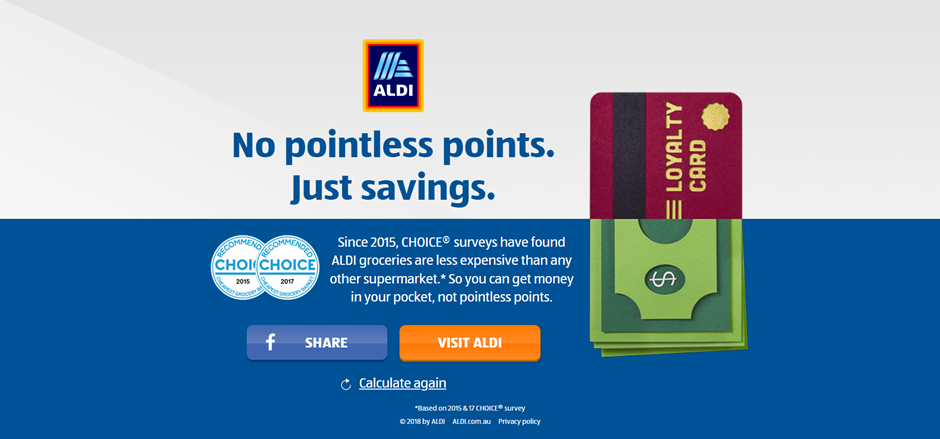
What about Aldi’s loyalty program? Aldi challenged the status quo and ridiculed Coles Flybuys and Woolworths Everyday Rewards loyalty programs through Aldi Pointless Points. A very successful campaign that was launched in 2018 and ran for more than 5 years, asked shoppers Why save pointless points when you can save money?
Aldi makes a very good (not pointless) point!
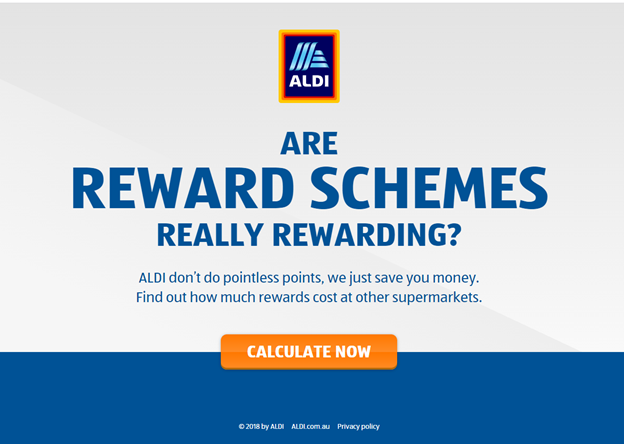
As part of the mockery, Aldi launched a loyalty calculator, aldiloyaltycalculator.com.au. Here consumers could see how long and how much they would need to spend to redeem a reward; but also, this gave people the chance to reassess whether being members of Flybuys or Everyday Rewards made sense.
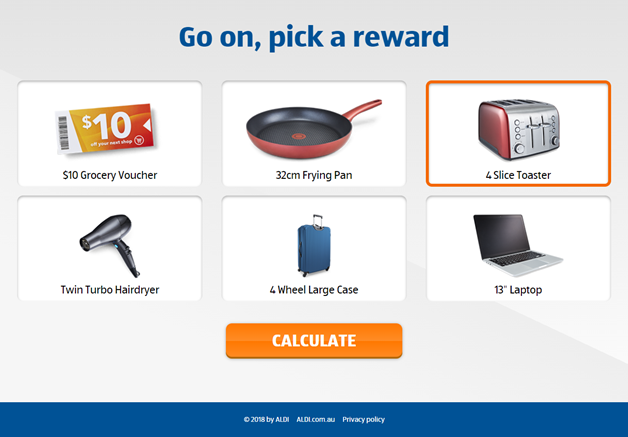
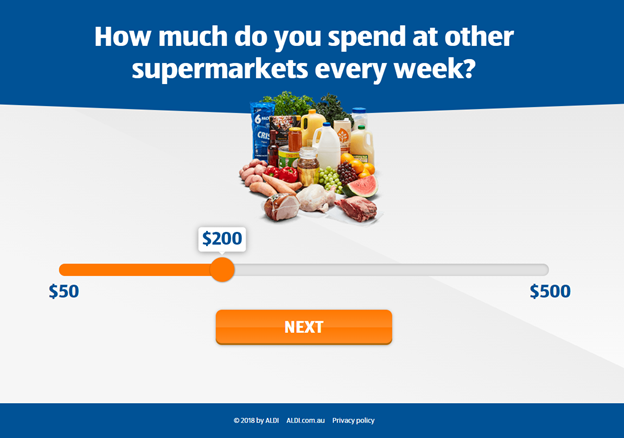
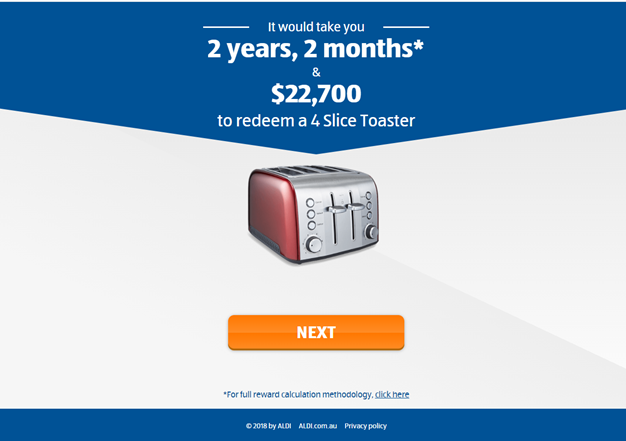
The calculator asked shoppers how much they spent at the supermarket per week. Then to pick a reward such as a pan, a toaster, a $10 voucher or a luggage piece, and the calculator then showed consumers the ridiculous amount of time and money they would need to spend to redeem a reward.
Say you spend an average of $200 per week in groceries and want to redeem a toaster. It would take you $22,700 and two years and two months. It doesn’t seem that appealing, right? But if you buy your groceries at lower prices (e.g., 2K Natural Greek Yoghurt at Aldi for $8.79 vs $11.95 at Woolworths or Coles $10.95 on promotion), supporting Aldi is a no brainer.
If you tell me Aldi’s low prices and a witty and snappy campaign revealing the quirks of a loyalty program engenders a following of shoppers that would only buy at Aldi, I totally agree.
The brand offers consumers what is important to them.
The cost of living keeps rising, and families are feeling it everywhere from petrol to groceries. If you’re a parent shopping for a whole family, you’ll know how quickly the weekly total adds up. It’s painful, so Aldi’s approach matters to them.
Loyalty programs must not fall into the points trap
I also agree that the calculator wasn’t perfect and could even be misleading. It devalued Coles and Woolworths’ programs by overly simplifying how their loyalty programs work, which have proven to be of much value to their members. But this is another conversation for another time.
The reality is, gathering thousands of points for minute rewards is hardly worth it for consumers, and for that matter, for brands too. Points are not the only loyalty program model to follow, and brands must consider other approaches. If they want to offer points, brands must think through what it is that the program design is providing in terms of value – not simply falling into the same trap.
Aldi has done a great job at identifying a common mistake a brand can easily make. What I really liked about their approach is that in a competitive market where there’s little differentiation, Aldi separated itself from the pack and confronted the big brands. Their strategy played a defining role in creating a habit to favour the bargain grocery store over others.
And here is the lesson, any loyalty approach must provide a differentiating value that matters to their customers. If you’re not doing so, your customers will vote with their feet. Aldi’s Pointless Points have increased sales by 9%.
Ready to take your loyalty program to the next level? Let our team of loyalty consultants help you create a customised strategy that works for your supermarket business. Contact us today to schedule a consultation and learn how we can help you boost customer loyalty and drive sales.
Explore our full range of loyalty consulting services here.