The stamp card is one of the most widely used loyalty program designs in the world. A customer earns a stamp with each purchase, and once the card is complete, a free product is unlocked. The format is simple, cheap to operate, and commercially elegant. It effectively provides loyal customers with a delayed cumulative discount while non-loyal customers continue to pay full price.
What has changed in the past decade is the container. Paper cards have been replaced, extended, or mirrored by app-based stamp cards, Apple Wallet and Google Wallet passes, tap-to-stamp hardware and progress trackers built into the loyalty tab of a brand’s mobile app. While the underlying psychology is the same, the data, personalisation and fraud protections are radically better.
As a loyalty consultant, I am a sucker for a good stamp card. We have several case studies in our book Loyalty Programs: The Complete Guide but I wanted to profile five standout stamp card loyalty programs currently operating globally. This article examines the design choice behind each one, summarises the academic evidence that explains why the format works and closes with two emerging probabilistic design variants that Loyalty & Reward Co sees as underexploited opportunities for the next generation of stamp card programs.
What is a stamp card loyalty program?
A stamp card loyalty program rewards members with a stamp (or punch, bean, star, or other symbol) each time they make a qualifying purchase. Once the card is full, the member unlocks a pre-defined reward, most commonly a free item from the brand’s range.
Three structural variants dominate. A basic stamp card awards one stamp per transaction and a single reward when the card is complete. A complex stamp card awards a stamp per transaction but calculates the reward as a percentage of total spend, which suits categories with variable basket sizes. A multi-stamp card runs several stamp cards inside one program, allowing members to progress across multiple reward categories at the same time. For a deeper look at each variant with worked examples, see Loyalty & Reward Co’s framework piece on basic, complex, and multi-stamp card design variants.
The design works because members see visible progress toward a concrete goal. That progress is the commercial asset. It is what turns a one-off customer into a repeat customer and then into a habitual one.
Why do stamp card loyalty programs still work?
Two well-established psychological effects explain the durability of the stamp card format. Both have been documented in peer-reviewed research and both show up in the design decisions brands are still making today.
The endowed progress effect
Nunes and Drèze (2006) ran a field experiment using a car wash stamp card. One group was given an 8-stamp card with no free stamps. A second group was given a 10-stamp card with 2 free stamps already printed on it. Both groups needed 8 stamps to earn the reward. The second group redeemed at 34%, almost double the 19% redemption rate of the first group, and transacted more frequently along the way.
The conclusion is the foundation of most modern stamp card design: members given even a small artificial head start toward a goal show greater persistence in reaching it. Welcome stamps, sign-up bonuses, and ‘you’re already 20% of the way there’ onboarding flows are all direct applications of this finding. Loyalty & Reward Co covers the broader application of this principle in its deep dive on the endowed progress effect.
The goal gradient effect
First documented by Hull (1934) and extended to consumer behaviour by Kivetz, Urminsky and Zheng (2006), the goal gradient effect states that motivation to reach a goal increases as the goal gets closer. In their coffee-card study, members purchased coffee more frequently the nearer they were to earning their free cup.
This is why progress trackers, countdown messaging (“1 stamp until your reward”), and targeted bonus-stamp offers tend to appear in the last third of a member’s journey. The back half of a stamp card is where the commercial upside is, and well-designed programs lean into it. For a wider treatment of this phenomenon across loyalty psychology, see Loyalty & Reward Co’s article on the goal gradient effect in consumer behaviour.
Which brands run standout stamp card loyalty programs today?
The five global examples below cover hospitality, quick-service food, and beauty services. Each has been chosen because it illustrates a specific design choice and offer practical things a strategist or marketer can take away and adapt rather than because it is the largest or most-marketed program in its category.
Pret Perks (UK) – a transaction-based digital stamp card
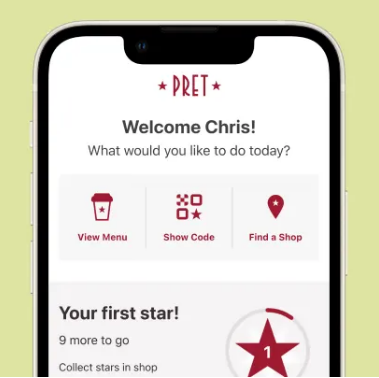
Pret A Manger’s Pret Perks program, available in the Pret app, rewards members with one star per paid transaction. Collecting 10 stars unlocks a free item from a defined rewards range. The program explicitly counts transactions rather than spend, which keeps the mechanic simple and easy to communicate.
The design choice worth noting is separation. Pret also operates Club Pret, a paid coffee subscription that gives members half-price barista-made drinks. Pret Perks runs in parallel, and members continue earning stars on non-subscription purchases. This stacked model, a stamp card for visit frequency plus a subscription for coffee volume, gives Pret two distinct commercial levers without either one cannibalising the other.
For loyalty strategists, Pret Perks is a useful reference for food and beverage operators asking whether to reward per-dollar-spent or per-visit. Per-visit keeps basket-size pressure off the member and reinforces habit frequency, which is what the stamp card format was built for.
Nando’s Rewards Chillies (UK) – a tiered digital stamp card
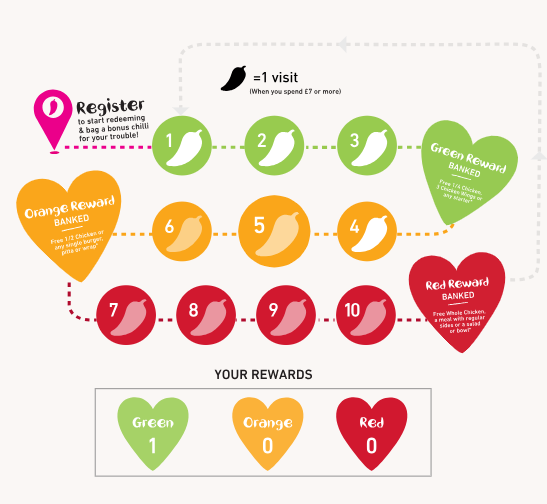
Nando’s UK operates a digital stamp card called Chillies. New members receive a bonus Chilli on registration, and from there earn one Chilli for every order of £7 or more, whether they eat in, collect, or order delivery. Rewards are banded: 3 Chillies unlock a Green Reward, 6 Chillies unlock an Orange Reward and 10 Chillies unlock a Red Reward, with all rewards expiring one year after issue.
This is a hybrid of a stamp card and a tiered redemption structure. Instead of the classic ‘collect 10, get 1 free’ single-threshold design, Nando’s gives members three redemption checkpoints at increasing reward values. The welcome Chilli is a textbook application of the endowed progress effect. Members start their card already feeling partway toward the first reward, which the Nunes and Drèze (2006) car wash research shows materially lifts redemption rates. Members who would normally churn around stamp 4 or 5 have a near-term reason to come back and members chasing the bigger Red Reward have a clear long-term goal.
It is also a good illustration of a minimum-spend condition. The £7 qualifying threshold prevents gaming through low-value add-on purchases, which has historically been a vulnerability for basic stamp cards in quick-service restaurants.
Grill’d Relish (Australia) – a visit-based stamp card with a social-giving option
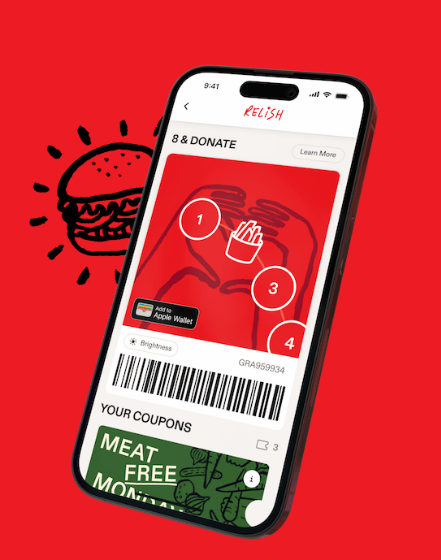
Australian burger chain Grill’d runs a visit-based digital stamp card called Relish through its app. The structure uses three unlock points rather than one. Free chips are awarded on the member’s 2nd qualifying visit, a free standard drink on the 5th, and a free burger on the 8th. Members also receive a free serve of chips every day of their birthday month.
The design decision that sets Relish apart is what happens at the 8th visit. Rather than simply redeeming the free burger, the member can choose to donate the cost of a meal to St Vincent de Paul (Vinnies) instead. This gives the program a charitable redemption path that converts individual reward equity into brand goodwill and community outcomes.
Commercially, the multi-unlock structure solves the classic ‘first third of the card is emotionally flat’ problem by giving members a reward inside two visits. Strategically, the donate option is a way to embed purpose into the rewards catalogue without adding operational complexity elsewhere in the business.
itsu rewards (UK) – non-linear thresholds on a £5 minimum
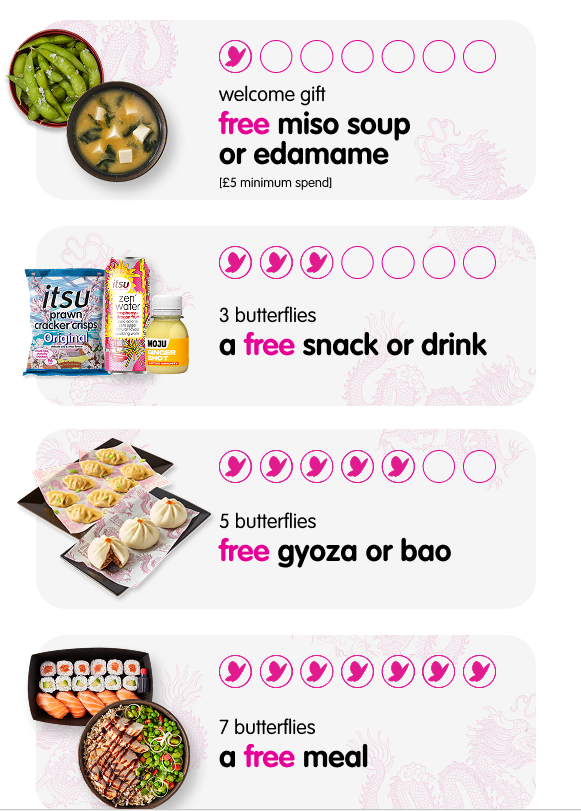
UK-based pan-Asian food chain itsu runs a digital stamp card program in which members collect butterflies, one per order of £5 or more, through the itsu app. Rewards are triggered at the 3rd, 5th, and 7th butterfly, plus a sign-up welcome gift and birthday treats.
The distinctive design element is the non-linear threshold spacing. Instead of an even 3-6-9 cadence, itsu uses 3-5-7. The gap narrows as the member progresses, which keeps the back half of the journey feeling achievable and applies the goal gradient principle in reverse, smaller remaining distance between rewards as commitment builds.
It also reflects a product mix reality. itsu’s average order value and visit frequency are different to a coffee shop’s and the 3-5-7 structure calibrates rewards to a realistic customer lifecycle rather than a generic ‘buy 9, get 1 free’ template borrowed from cafés.
Deka Lash (USA) – a dual stamp card that solves the no-show problem
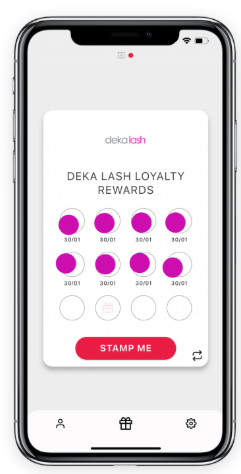
Deka Lash is a multi-state US lash bar franchise. As documented by the brand’s digital loyalty platform partner, the program runs two separate stamp cards in parallel for each member, with each card serving a different commercial objective.
The main loyalty card is structured around 20 stamps with multiple interim rewards along the way: 5 stamps unlocks free makeup remover pads, 10 stamps a complimentary lash brush, 15 stamps $20 off services, and 20 stamps a free lash refill, after which the card resets and the member starts collecting again. Members earn one stamp per lash appointment attended.
The distinctive design choice is the second card, a Prebooking Reward, which sits alongside the main card and gives members a 10% discount once they have prebooked 10 appointments. This is a stamp card built explicitly to address a commercial pain point in the appointment-based services category; no-shows and late cancellations. Rather than penalising the unwanted behaviour, the program rewards the inverse and uses the stamp card mechanic to embed prebooking as a habit. For loyalty strategists in salons, dental practices, fitness studios, allied health, and any other category where forward bookings drive utilisation, the Deka Lash structure is a useful template for using a parallel stamp card as an operational lever rather than a marketing one.
What do these stamp card programs have in common?
Despite their differences in category, geography and tech stack, the five examples share four design choices that are worth calling out explicitly for anyone designing or redesigning a stamp card program.
A single, instantly-understandable core mechanic
Every one of the programs can be explained in a single sentence. ‘Ten stars is a free item.’ ‘Three, six, or ten Chillies unlock Green, Orange, or Red rewards.’ ‘Visit eight times, get a free burger.’ ‘Twenty lash appointments, plus interim rewards along the way.’ Complexity kills stamp cards. Clarity is the design principle.
Progress made visible
All five programs present the member with a visual tracker that shows stamps earned and stamps remaining. This directly applies the goal gradient and endowed progress effects. A stamp card where members have to mentally calculate their progress is a stamp card that underperforms.
A transaction or visit trigger, not a pure dollar trigger
All five examples reward frequency of transactions, visits, or appointments rather than pure spend. This keeps the mechanic honest and resistant to gaming, reinforces habit formation, and stops the program feeling like a rebate scheme. Minimum-spend conditions (Nando’s £7, itsu £5) are used to prevent trivial qualifying purchases, but the core trigger remains the repeat behaviour.
A digital container, even when the format is traditional
None of these programs are paper-first. The app or wallet pass is the default, and in most cases the only option. That matters commercially because the digital container is what makes modern data capture, fraud prevention, personalisation, and push messaging possible, all of which extend the economic value of the stamp card format well beyond a free coffee.
Which stamp card design variants are still underexploited?
The five programs above are well-executed examples of the stamp card format as it is currently deployed. Looking at consumer psychology research and the gamification mechanics that have emerged in adjacent loyalty categories, there are some interesting design variants that very few brands have deployed at scale and that we consider strong candidates for the next wave of stamp card innovation.
Both variants are grounded in decades of behavioural research showing that unpredictable rewards drive stronger engagement than predictable ones. Exciting studies are happening in this space. Scholars like Dr Adrian Camilleri, Associate Professor at the University of Technology Sydney, whose research on consumer decision-making under uncertainty informs the design logic below. These variants are presented here as design patterns, not as live case studies, to help program operators think through their next iteration. They also build on a broader Loyalty & Reward Co thesis on injecting randomness into loyalty program design to boost engagement.
The probabilistic stamp card
The core mechanic is unchanged, for example, 9 stamps unlocks a free drink, but a layered probabilistic element is added. After each qualifying transaction, the member has a fixed chance (for example, 10 percent) of instantly collecting all remaining stamps on their card. In effect, every visit carries both a guaranteed stamp and a small shot at completing the card outright.
The psychological case for this design is strong. Pagnoni et al (2002) used MRI imaging to show that unexpected rewards produce a substantially stronger dopamine response in the brain’s pleasure centre than predictable rewards of equal value. A probabilistic stamp card converts every purchase into a small moment of anticipation, which keeps the program emotionally active between guaranteed reward redemptions. It also leans directly into the Lucky Loyalty Effect identified by Reczek, Haws and Summers (2014): loyal customers perceive themselves as more likely to win random promotions associated with brands they are loyal to, which increases their willingness to participate.
Commercially, the probabilistic stamp card gives a program operator a tunable engagement lever. The win-rate can be dialled up during low-trading periods to pull forward visits, or dialled down outside them. The total reward cost remains bounded because only one completion can be triggered per card.
The escalating probabilistic stamp card
A variant that adds a further layer. The chance of instantly completing the card rises with each stamp earned. For example, the probability might start at 2 percent on the first stamp and rise to 20 percent on the ninth, so that the closer the member is to the guaranteed reward, the more likely each visit is to short-circuit the final stamps.
The escalating structure is a direct and deliberate application of the goal gradient effect. Hull (1934) and Kivetz, Urminsky and Zheng (2006) showed that motivation to complete a goal rises as the goal gets closer. The escalating probability compounds that natural motivation by making each successive visit in the back half of the card not only closer to the reward but also more likely to unlock it early. The ‘one more visit’ argument gets steeper, not flatter, as the member progresses.
This design is operationally slightly more complex than the flat-probability variant because the probability curve must be modelled and the reward cost projected across the member base. It is best suited to brands with strong transaction data and a loyalty platform capable of variable-probability rule logic which most modern digital stamp card platforms already support, even if the feature is not yet widely promoted.
Why these variants are rare in the market today
The short answer is that most brands treat the stamp card as a legacy format and under-invest in innovating on it. The industry focus is overwhelmingly on points programs and tiered memberships, which are perceived as more sophisticated. The stamp card gets a digital refresh and then sits untouched. That is the opportunity. A brand willing to layer a probabilistic completion mechanic onto an existing stamp card program, even as a time-bounded campaign, can generate measurable uplift in visit frequency and create an engagement talking point that none of its category peers are running. Chipotle Rewards already deploys variable-ratio mechanics elsewhere in its program through its ‘Extras’ feature, which delivers randomised bonus rewards, surprise free menu items, and instant-win moments to members on transactions they cannot predict. A useful proof point that randomness works commercially in mainstream hospitality loyalty, even if the specific stamp card application has yet to be deployed at scale.
When should a brand choose a stamp card over a points program?
Stamp cards are best suited to businesses with consistent purchase frequency and relatively uniform transaction values. Cafés, bakeries, quick-service restaurants, car washes, salons, and lunchtime food retailers are the typical fits. The format breaks down when transaction values vary wildly, because giving the same reward for a $3 purchase and a $30 purchase feels arbitrary to the customer.
Points programs are more flexible. They scale with spend and can fund a broader rewards catalogue but they also demand more cognitive effort from the member and more operational investment from the brand. For high-frequency, low-complexity categories, a well-designed stamp card will typically outperform a points program on engagement, cost to serve, and time to first reward.
A hybrid is often the right answer for brands whose customer base is not uniform. Pret A Manger’s co-existing Pret Perks stamp card and Club Pret coffee subscription is one practical model for running two mechanics side-by-side without diluting either.
FAQs about stamp card loyalty programs
What is a digital stamp card?
A digital stamp card is a mobile-first version of a traditional paper punch card. Instead of a physical stamp, the member earns a digital mark within a brand’s app, Apple Wallet, or Google Wallet pass. Digital stamp cards remove the risk of lost cards, provide real-time progress tracking, and allow the brand to capture transaction data the paper format cannot.
How many stamps should a loyalty stamp card require?
There is no universal number, but most successful programs sit between 7 and 10 stamps for the main reward, with minor rewards at interim checkpoints. The right number depends on the customer’s natural purchase frequency and commercial modelling underpinning the program. A weekly visitor should be able to reach a reward within 8 to 10 weeks; a daily visitor within two weeks. Longer cycles risk member drop-off.
Do digital stamp cards perform better than paper ones?
In most categories, yes. Digital stamp cards eliminate the lost-card problem, provide verifiable progress for the member, enable direct messaging, and give the brand a dataset on who is actually engaging. They also materially reduce the fraud risk that affected some paper stamp programs in the 2000s. Paper cards still work for small or more traditional operators.
Can a stamp card program be combined with a points or tier program?
Yes, and it often works well. A stamp card drives short-term visit frequency while a points or tier program rewards longer-term value. The two mechanics answer different questions for the member, ‘am I close to a free coffee?’ versus ‘what status or cumulative benefits do I have with this brand?’, and with the right design can sit alongside each other without friction.
What is the biggest risk with stamp card loyalty programs?
Discounting loyal customers who would have visited anyway. A stamp card that rewards frequency gives away margin to the brand’s best customers without changing their behaviour. Good stamp card design mitigates this by making the reward category one the customer would not otherwise buy (an add-on, a premium upgrade, or a trial of a new product) rather than a discount on their usual order.
What is a probabilistic stamp card?
A probabilistic stamp card layers a chance-based completion mechanic over a traditional stamp card. The member still earns a guaranteed stamp per qualifying transaction, but each purchase also carries a set probability of instantly filling the rest of the card. The design draws on the neuroscience of unexpected rewards and the Lucky Loyalty Effect to drive stronger engagement than a purely linear stamp card.
Are stamp cards right for your loyalty program?
Loyalty & Reward Co helps brands design, implement and optimise loyalty programs globally. If you are considering a new loyalty program or optimising an existing one we can help assess the most effective frameworks to drive the outcomes and behaviours you are after.
Contact the team at loyaltyrewardco.com to start a conversation.
Academic research:
- Nunes, J. & Drèze, X., 2006, ‘The Endowed Progress Effect: How Artificial Advancement Increases Effort’, Journal of Consumer Research, Vol 32, Iss 4, pp504-512.
- Kivetz, R., Urminsky, O. & Zheng, Y., 2006, ‘The Goal-Gradient Hypothesis Resurrected: Purchase Acceleration, Illusionary Goal Progress, and Customer Retention’, Journal of Marketing Research, Vol 43, pp39-58.
- Reczek, R. W., Haws, K. L. & Summers, C. A., 2014, ‘Lucky Loyalty: The Effect of Consumer Effort on Predictions of Randomly Determined Marketing Outcomes’, Journal of Consumer Research, Vol 41, pp1065-1077.
- Pagnoni, G., Zink, C. F., Montague, P. R. & Berns, G. S., 2002, ‘Activity in human ventral striatum locked to errors of reward prediction’, Nature Neuroscience, Vol 5, pp97-98.