
This article is an excerpt from Chapter 20 of Loyalty Programs: The Complete Guide (3rd Edition) by Philip Shelper. The chapter was co-written by Ryan De Boer, CFO of Loyalty & Reward Co.
Loyalty program commercial design is the discipline of deciding how a program is funded, how its currency is issued and priced, how its liability is managed, and how it earns a positive return. Loyalty & Reward Co treat it as equal in importance to member-facing design, and guide it with the Loyalty Commercial Value Framework™.
Loyalty programs as commercial assets
In 2020, at the height of the Covid-19 pandemic, the major US airlines needed to raise capital urgently. Aircraft were grounded and passenger revenue had collapsed by as much as 90 per cent. The assets they pledged as collateral were their loyalty programs. United raised US$6.8 billion secured against MileagePlus, Delta raised US$9 billion against SkyMiles, and American followed in 2021 with US$10 billion secured against AAdvantage. In under a year, three loyalty programs had been used to secure close to US$26 billion of funding.
The financings made explicit what airline financial statements had long implied, which is that a loyalty program can be worth a substantial portion of the airline that operates it. On Point Loyalty’s 2026 valuation of the world’s airline loyalty programs estimated SkyMiles at US$31.8 billion, AAdvantage at US$26.7 billion, and MileagePlus at US$25.3 billion.
The airline story is the most visible example of the shift, and it is far from isolated. Grocery retailers run media brands fuelled by loyalty data, coalition operators sell their currencies to banks and merchants at a margin, and subscription programs generate recurring fee income that funds member benefits many times over. Across sectors, the largest loyalty programs have become commercial brands in their own right, operating inside the companies that own them as highly profitable divisions.
Loyalty programs as an investment
Historically, loyalty programs have often been treated as marketing initiatives, positioned primarily as retention tools and funded from the same budgets as advertising campaigns. For many companies, that remains the case today. A program treated as a marketing expense will be designed as one, measured in engagement metrics, reviewed annually when budgets are set, and cut when trading conditions tighten. A program managed as an investment will be designed with commercial rigour, with funding sources that are modelled, liabilities that are actively managed, returns that are measured against the company’s cost of capital, and design decisions that receive the same scrutiny as any other allocation of capital.
The framing also determines who is involved in the loyalty program design. Loyalty programs tend to reside within marketing functions, where the teams are skilled at member experience, communications, and creative execution. Those teams are not typically staffed to model deferred revenue liabilities, breakage assumptions, or funding structures. The consequence is that many programs are designed marketing-first, with the commercial questions answered afterwards. Earn rates are set to look competitive instead of to be sustainable, reward catalogues are priced by intuition, and liabilities are discovered instead of planned.
The root cause is an operating model that asks a single function to carry a commercial responsibility alone. A program intended to become a significant commercial asset needs finance embedded in its design from the first workshop.
The two-sided value equation
Every loyalty program has to satisfy two parties at once. Members join because they expect to access value in the form of rewards and benefits. Brands invest because they expect to generate value in the form of incremental member acquisition, spend, retention, cost savings, advocacy, and data insights.
Programs that deliver overwhelming value to the member but insufficient value to the brand become unaffordable, and are eventually devalued or discontinued, damaging the trust they were built to create. Programs that deliver overwhelming value to the brand but insufficient value to the member cease to function as loyalty programs, as members disengage and the program becomes an administrative overhead. The best programs sit deliberately between these failure modes, delivering enough perceived value to stimulate desirable member behaviours and enough commercial return to justify continued investment. Striking that balance is the central task of loyalty program commercial design.
The Loyalty Commercial Value Framework™
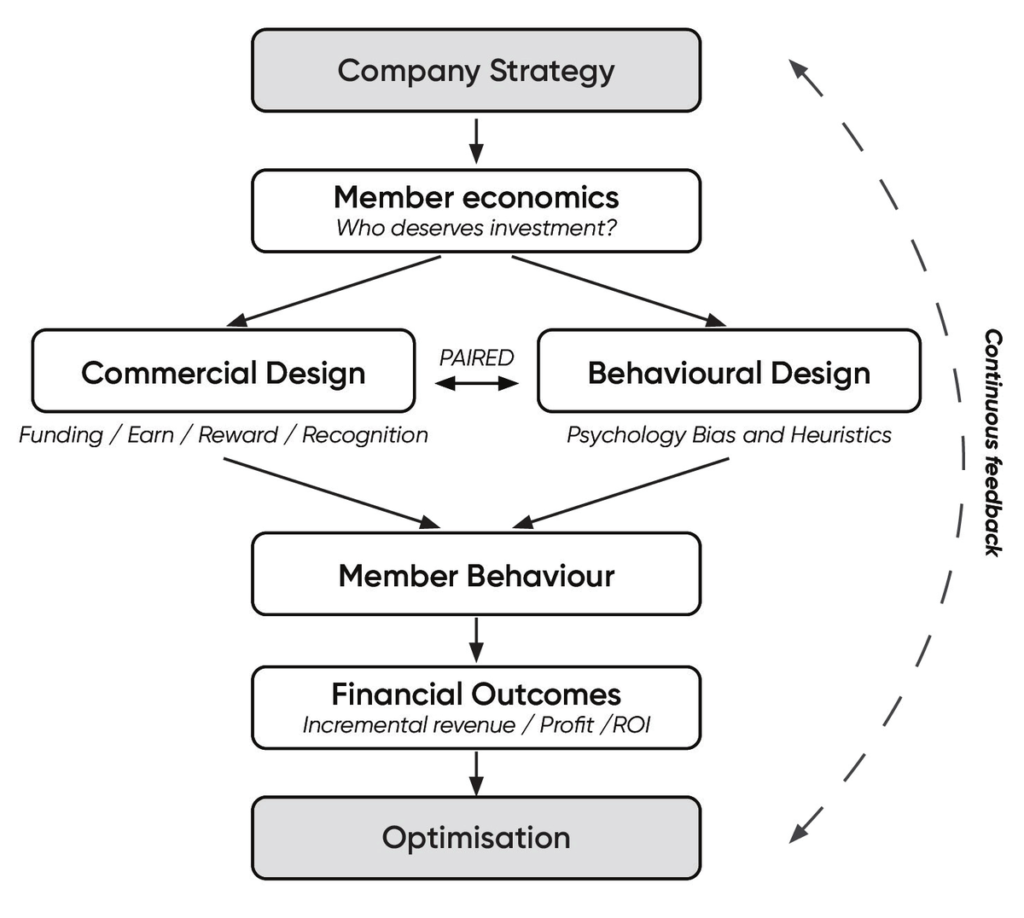
Loyalty & Reward Co’s Loyalty Commercial Value Framework™ guides the commercial design process. Company strategy sits at the top of the framework because every program decision should trace back to a commercial objective the brand aims to achieve. Member economics sits beneath it and determines which members deserve investment. Two paired disciplines follow.
- Commercial design covers the funding model, the earn model, reward economics, and liability management
- Behavioural design covers the member behaviours the program stimulates and the psychological principles, biases, and heuristics it applies to stimulate them
Both disciplines act on member behaviour, which produces the financial outcomes of incremental revenue, profit, and return on investment (ROI). Optimisation then feeds back to the top of the framework in a continuous loop.
The framework is a systems diagram in which a change to one element moves all the others. A change to the earn rate moves the liability curve, the funding requirement, the redemption mix, and the reported financial outcomes. Seeing the program as a connected commercial system is critical for achieving an optimal outcome.
Commercial and behavioural design together
The consequences of having one discipline without the other are visible across the industry. A program with strong commercial design but weak behavioural design is financially sound and inert, with sustainable earn rates and well-priced rewards, and no clear reason for a member to change how they engage with the brand. A program with strong behavioural design but weak commercial design is engaging and unaffordable, with members responding enthusiastically to campaigns whose costs were never modelled, until the program is devalued to pay for its own success.
Commercial design in practice
The chapter describes a pattern that can emerge when a loyalty program sits within marketing alone. Commercial questions may be answered after the program is designed, with earn rates set to look competitive and reward catalogues priced on intuition. In those cases, the liability tends to be discovered later instead of planned from the start.
Loyalty & Reward Co address this by bringing commercials into the design discussion early. The Loyalty Commercial Value Framework™ gives marketing and finance a shared view of how each design decision flows through to profit. When both teams can see that an earn rate change also moves the liability, the funding requirement, and the reported return, decisions tend to improve.
Chapter 20 was co-written by Loyalty & Reward Co’s CFO, Ryan De Boer, which reflects the same principle. Commercial design is a finance discipline as much as a marketing one.
Frequently asked questions
What is the difference between loyalty program design and commercial design?
Program design covers what members see and do, such as earn mechanics, rewards, tiers, and communications. Commercial design covers how that experience is funded, priced, accounted for, and measured. Loyalty & Reward Co treat the two as paired disciplines, since a change to one moves the other.
Who should be involved in loyalty program commercial design?
Marketing, finance, and analytics. Marketing identifies the member behaviours worth stimulating, finance models funding, liability, and return, and analytics confirms the outcomes can be measured. Involving finance from the first design workshop reduces the risk of unsustainable earn rates and unplanned liabilities.
Can a loyalty program be a profit centre?
Yes. Several of the largest airline programs have been independently valued at more than US$25 billion each. Grocery, coalition, and subscription programs also earn direct revenue from retail media, currency sales, and member fees.
This article is an excerpt from Loyalty Programs: The Complete Guide (3rd Edition) by Philip Shelper, the most comprehensive book on loyalty programs available. To discuss loyalty program design, talk to a Loyalty & Reward Co consultant.
Sources
- United Airlines Holdings, 2020, United Announces Completion of MileagePlus Senior Secured Notes Offering, SEC Form 8-K
- Delta Air Lines, 2020, Delta Air Lines Announces Upsize of SkyMiles Financing to $9 Billion
- American Airlines Group, 2021, American Airlines Announces Upsize of AAdvantage Financing to $10.0 Billion, SEC Form 8-K
- On Point Loyalty, 2026, Top 100 Most Valuable Airline Loyalty Programs 2026
Related reading
- How do you measure loyalty program incrementality? (article 2 in this series)
- How do the commercial levers of a loyalty program connect? (article 10 in this series)
- How do you build a loyalty program business case? (article 6 in this series)
- Why brands run loyalty programs: opportunities & challenges (Philip Shelper) at loyaltyrewardco.com