
Inside Australia’s loyalty industry: what the ACCC report revealed

26 May 2020
Stacey Lyons

If loyalty programs aim to positively influence consumer behaviour, then understanding how consumers make decisions and the factors that influence decision making is an important area of research in loyalty psychology.

I’ve seized the gift of time that isolation has dealt in order to deep dive into the biases which impact consumer thinking patterns and determine how loyalty programs can design specific elements of their program to appeal to specific consumer biases.

The Endowment Effect and Loss Aversion biases are the most applicable to a wide number of loyalty program design frameworks. Their effects have loyalty program members flying across the world for no reason or spending larger sums of money for fear of losing a small discount.

This article explains these biases, how they’ve developed and how loyalty programs are benefiting from them.

What is the Endowment Effect and Loss Aversion bias?

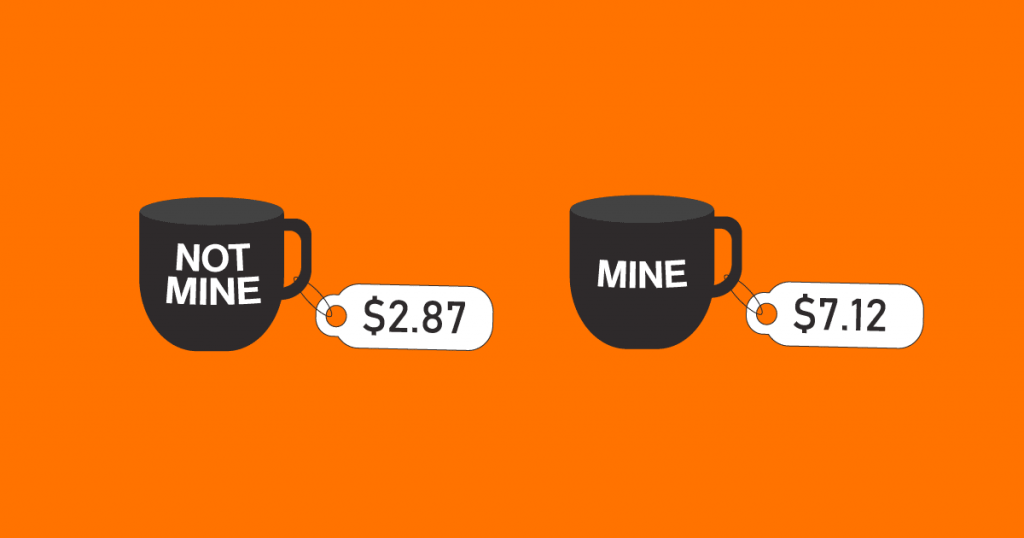
An endowment effect bias (as illustrated by the image above) occurs when people irrationally overvalue an object they own, regardless of its objective market value, whereby ‘people often demand much more to give up an object than they would be willing to pay to acquire it.’(Thaler, 1980)[1].

Kahneman et al (1991)[2] ran a series of experiments to test the endowment effect. In one experiment, 77 students were randomly assigned roles as buyers or sellers, with sellers provided with university-branded coffee mugs. Few trades ensued, with sellers asking for an average $7.12 for a mug, while buyers only wanted to pay an average $2.87. The experience suggested that the low volume of trade was primarily produced by the seller’s reluctance to give up their endowment, rather than by buyers’ unwillingness to spend their cash.

Endowment affect is closely related to loss aversion.

Kahneman & Tversky (1979)[3] then conducted a series of experiments where subjects were asked to choose between more or less risky propositions which provided the potential to win or lose money (e.g. an equal chance of winning or losing $100). They found ‘the aggravation that one experiences in losing a sum of money appears to be greater than the pleasure associated with gaining the same amount,’ and that most people find symmetric bets of that form to be distinctly unattractive.

These findings have led to the development of strategies whereby workers and students have been motivated by penalties rather than rewards. Hossain & List (2012)[4] determined that framing outcomes as penalties resulted in improved performance in a Chinese production factory. Fryer et al (2012)[5] demonstrated that exploiting the power of loss aversion, where teachers were paid in advance and asked to give back the money if their students do not improve sufficiently, increased math test scores by more than one standard deviation. People are more willing to take risks or behave dishonestly to avoid a loss than to make a gain. A study by Schindler & Pfattheicher (2016)[6] used a die-under-the-cup game and a coin-toss task, with the opportunity for participants to engage in dishonest behaviour either to avoid a loss (loss condition) or to approach an equivalent gain. Their results found that people show more dishonest behaviour to avoid a loss.

According to Ries (2012)[7], some private fitness centres allow people to invest their own money in weight-loss incentives, for example, by putting in $200 and receiving a portion back as they achieve incremental weight-loss goals. Websites like www.stickK.com operate on the same basis in the online environment. They help people achieve goals via a ‘Commitment Contract’; a binding agreement which involves putting money on the table to ensure the user follows through with their intentions using loss aversion.

How loyalty programs appeal to the Endowment Effect and Loss Aversion bias:

Loss aversion is used extensively in loyalty programs (and marketing strategies more widely) to stimulate member engagement. Programs can provide members with something which they feel ownership for and value, and then establish conditions whereby they might have ownership removed. This can act as a motivational force to compel the member to continue.  This includes the threat of status tier members losing their benefits if they fail to earn enough status credits, members suffering their points to expire if they do not engage with the program on a regular enough basis (or redeem them in time) and members not being able to access desirable rewards (reward seats, hotel rooms, etc) or having to spend a greater amount of points if they do not book early enough.

Two examples of companies benefiting from these biases include:

  1. Qantas Frequent Flyer (the status tier framework)

    A ‘status run’ involves members of a frequent flyer program taking a flight with the soul purpose of earning enough status credits to ensure their status tier is maintained. A nice destination or the number of frequent flyer points earned for the trip are secondary considerations.

    If a member has not flown enough in a calendar year to qualify or re-qualify for a premium status, sometimes there is a business case for a status run to make sense to the member due to the high value placed on the benefits they stand to lose. Qantas is considered the leader of the pack for members taking status runs, given the need for Australians to travel long haul and the desire for the process to be as comfortable as possible.[1]

    Australian Frequent Flyer[2] (among other websites) have put together a list of best Qantas status run paths of 2020 where members could pick up a flight with the necessary status credits for the lowest cost. They also advise readers to keep a lookout for the double status credit promotions run by Qantas which are becoming increasingly more frequent – Qantas have recognised the patterns of ‘status runners’ and have adjusted their promotions to appeal to them by offering regular status credit promotions on certain routes rather than offering sale prices.

    Thus, the status run has been formed by members actively avoiding losing access to their tier benefits or losing the progress they’ve made towards the next tier and subsequent promotions have been built off the back of this.

  2. Modern Market Rewards (the delayed credit framework)

    The credit program framework is where members earn credit to their account for future spend on the company’s products.

    As a join bonus, customers who sign up to Modern Market Rewards receive $2 credit into their account aimed at immediately encouraging them to spend at Modern Market to take advantage of their credit. Every time the member dines at Modern Market they progress towards earning their next $10 credit. A $10 credit is triggered ready for redemption each time a $100 spend threshold is reached, encouraging continuous earn activity to progress towards more credits. An expiry is also placed on the credits to generate FOMO, feeding into the endowment effect and loss aversion biases.

Summary

Loyalty programs have consumers making decisions to act in a way which seems completely irrational (i.e flying across the world for status credits or spending large sums to avoid losing a discount). But this is the exact nature of biases. They frame our thinking patterns and cause us to make judgments and decisions without looking at the bigger picture. Programs who have been successful in understanding and appealing to consumer biases have made a rational decision to realise the benefits.

[1] Thaler, Richard, “Toward a Positive Theory of Consumer Choice,” Journal of Economic Behavior and Organization, 1980, 1, 39-60.

[2] Kahneman, D., Knetsch, J. L., & Thaler, R. H. (1991). Anomalies: The endowment effect, loss aversion, and status quo bias. Journal of Economic Perspectives, 5(1), 193-206.

[3] Kahneman, D. and Tversky, A. (1979). Prospect Theory: An Analysis of Decision under Risk, Econometrica, vol. 47, issue 2, 263-91

[4] Hossain, Tanjim & List, John. (2009). The Behavioralist Visits the Factory: Increasing Productivity Using Simple Framing Manipulations. National Bureau of Economic Research, Inc, NBER Working Papers. 58

[5] Fryer, R. G., Levitt, S. D., List, J. and Sadoff, S. 2012. “Enhancing the Efficacy of Teacher Incentives through Loss Aversion: A Field Experiment,” NBER Working Papers 18237, National Bureau of Economic Research, Inc.

[6] Schindler, S., & Pfattheicher, S. (2017). The frame of the game: Loss-framing increases dishonest behavior. Journal of Experimental Social Psychology, 69, 172-177.

[7] Ries N. M. (2012). Financial incentives for weight loss and healthy behaviours. Healthcare policy = Politiques de sante, 7(3), 23–28.

[8] Financial Review, ‘How to make those airline ‘status runs’ count’, 4th April 2019, https://www.afr.com/work-and-careers/management/how-to-make-those-airline-status-runs-count-20190327-h1cvpr, accessed 11th May 2020

[9] Australian Frequent Flyer, ‘The Best Qantas Status Runs in 2020’, 15th February 2020, https://www.australianfrequentflyer.com.au/qantas-status-runs/, accessed 8th May 2020
ACCC logo

Drawn from the report Loyalty & Reward Co produced for the Australian Competition and Consumer Commission, June 2019.

Almost 80 per cent of Australians belong to at least one loyalty program. That figure, from Mastercard research,1 shows how deeply loyalty programs are woven into Australian consumer life. It does not tell you how much value members actually receive, how the largest programs earn their profits, or what the design choices behind the points mean for competition. Those questions are harder to answer, and until 2019 no one had answered them in public.

In 2019, the Australian Competition and Consumer Commission (ACCC) commissioned Loyalty & Reward Co to produce the first comprehensive, publicly available report on the Australian loyalty industry. The report examined the major programs with more than one million active members, most of them coalition programs, and set out how they are designed, how they are monetised, how they use member data, and what effect they have on competition and on consumers. You can read the full report on the ACCC website. The findings remain a useful reference for anyone designing or operating a program today.

This article summarises what the report found, and what each finding means for program operators.

A market that reaches into almost every industry

Loyalty programs have operated in Australia for several decades and now appear across almost every consumer industry. Estimates of how many programs the average Australian belongs to range from four (Adam Posner, For Love or Money 2018)2 to 6.1 (Mastercard).1 The report concentrated on the four largest coalition programs, Qantas Frequent Flyer, Woolworths Rewards, Velocity Frequent Flyer, and flybuys, because their scale and partner networks give them influence over a large share of Australian spending. A coalition program is one run by a central operator, where a network of partners rewards members with a common currency such as points.

The modern coalition program traces back to 1980, when American Airlines launched AAdvantage, the first frequent flyer program built on a reward currency of miles. Qantas Frequent Flyer followed in 1987 using points. Over the following decades, hotels, banks, supermarkets, and retailers built or joined coalition networks of their own.

Much of the recent history is a contest between two competing partnerships. In 2009, Woolworths partnered with Qantas Frequent Flyer, which grew the supermarket’s member base and gave Qantas a large population of members who rarely flew. Coles took full control of flybuys in 2011 and relaunched it, using cheaper points and supplier-funded bonus offers to compete. When Woolworths relaunched as Woolworths Rewards in October 2015 and replaced Qantas Points with a new currency earned only on selected products, members responded with sustained criticism, and the supermarket reversed much of the change within a year. By 2016, the industry had settled into two camps, Woolworths Rewards with Qantas Frequent Flyer, and flybuys with Velocity.

For operators: a currency change removes something members already value, and members tend to feel that loss more sharply than the gain meant to replace it. The Woolworths experience shows how quickly members react when a redesign reduces perceived value.

The psychology built into program design

The report set out the behavioural research that underpins program design. Several findings are worth knowing.

Operant conditioning (Skinner, 1948)3 holds that behaviour which is reinforced tends to be repeated. Bonus points for a specific action encourage members to repeat it. A related insight is that not all points are equal: the large airline, bank, supermarket, and hotel currencies are desirable enough to change where members choose to shop.

Social identity theory (Tajfel, 1978;4 Bhattacharya and Sen, 2003)5 holds that people fold the brands they identify with into their sense of self. Status tiers apply this directly. A Platinum frequent flyer receives lounge access, priority boarding, and upgrades, and that recognition can build an emotional connection to the airline. Status also raises switching costs, which can keep a member spending even when a competitor charges less for the same product.

The endowed progress effect (Nunes and Drèze, 2006)6 was demonstrated in a car wash study. Members given a card with two of ten stamps already filled redeemed at 34 per cent, against 19 per cent for members given a blank eight-stamp card, even though both groups needed eight stamps. Artificial early progress increased persistence toward the goal.

The goal-gradient effect (Hull, 1934;7 Kivetz, Urminsky, and Zheng, 2006)8 holds that effort increases as a goal comes closer. Members have been observed to accelerate their spending as they approach a status threshold.

Size heuristics describe how one hundred points can feel more rewarding than the one dollar of value it represents. Points let a program present value at a low cost to itself.

Surprise and delight can lift satisfaction well beyond what met expectations achieve. Berman (2005)9 reported that a delighted Mercedes-Benz customer had an 86 per cent likelihood of buying again, against 29 per cent for a merely satisfied one.

For operators: these mechanics work, and that is why they carry a duty of care. Design that manufactures progress or leans heavily on status can drive engagement, and it can also erode trust if members later feel the value was overstated.

How the largest programs earn their profit

A small number of coalition programs are highly profitable. Qantas Loyalty reported revenue of $1,546 million and earnings before interest and tax of $372 million in 2018.10

The report set out the standard coalition model with a worked example. A member spends $1,000 and earns 1,000 points. The program invoices the retailer at around 1.5 cents per point, so the retailer pays $15. When the member later redeems, the program values each point closer to one cent, or $10 for the 1,000 points. The program keeps the difference, roughly $5, a margin of about 33 per cent on that transaction. Across the hundreds of billions of points a large program can sell each year, those half-cents accumulate.

Two further mechanics matter. The first is breakage, the industry term for points that expire unused. Programs set expiry rules, for example 18 months of inactivity for Qantas Frequent Flyer, 24 months for Velocity, and 12 months for flybuys, and higher breakage translates directly into higher profitability. This is why some programs employ actuaries to model it. The second is deferred revenue. A program sets aside enough to cover future redemptions, and a holding of several billion dollars is not unusual for a large Australian coalition program, earning interest in the meantime.

Redemption value also varies by reward. A point redeemed on a flight might be worth one cent, on a gift card half a cent, and on a toaster around 0.25 to 0.35 cents. Pricing steers members toward redemptions that keep cash inside the business.

For operators: breakage and value-steering improve margins, and they sit in tension with member value. A program that optimises breakage too aggressively risks the disengagement that produces breakage in the first place.

The data behind the points

A loyalty program is one of the most effective ways to build a marketing database, because it links transactions to an identified individual over time. The report traced how far that data capability now extends.

Woolworths bought a half-share in analytics firm Quantium in 2013, gaining the ability to turn data from around 8 million loyalty cards into personalised offers. Data exchanges such as Data Republic, backed by Qantas Loyalty, Westpac, NAB, and ANZ, connect a broad network of organisations for secure data sharing. Data brokers can match a single member against tens or hundreds of external datasets, and one broker cited in the report, Rokt, described using billions of user records to personalise offers in real time.

For operators: members increasingly expect transparency and control over their data, a point the report emphasised. A program that collects widely without explaining clearly risks the trust that makes personalisation acceptable in the first place.

The competition question

The report examined whether loyalty programs affect competition, and the evidence points in more than one direction.

Consumer behaviour shows the effect is real. A 2018 Canstar Blue survey found that 21 per cent of shoppers who switched supermarkets did so to earn reward points, and 54 per cent of those who did all their shopping at one supermarket did so because of points.11 International research reaches similar conclusions. Lederman (2003)12 linked frequent flyer enhancements to gains in airline market share, with larger effects at hub airports. Cairns and Galbraith (1990)13 argued that programs raise switching costs and act as a sunk cost that a new entrant must match to compete. McCaughey and Behrens (2011)14 found frequent flyer members in the Netherlands willing to pay a premium of up to 6 per cent. Reichheld (1996)15 found that programs can reduce a member’s sensitivity to competing prices.

The concern is sharpest for smaller companies and new entrants. In a market of dominant duopolies, when the leading players both run large, engaged programs, the competitive tension between them can be neutralised while the barrier facing a new entrant without a comparable program rises. Norway took this seriously enough to ban the earning of points on domestic routes for a period, lifting the ban only in 2013 once domestic competition was judged robust.16

The evidence is not one-sided. Caminal and Claici argued that loyalty pricing can enhance competition by steering business between firms and lowering average transaction prices.17 Aldi, meanwhile, has campaigned directly against points-based programs, arguing that members who chase points routinely spend more, which suggests competitors view those programs as effective.

For operators: a program is a genuine competitive asset, and that same strength invites scrutiny where it raises switching costs or dampens price competition. Designing for real member value, rather than lock-in alone, is the more durable position.

Are members getting what they are promised?

The report closed on the question that matters most to members: the value they actually receive.

Value varies widely. Members of some programs receive as little as half a cent for every dollar spent, while others return 10 per cent or more. Some programs have also reduced value quietly over time. A $100 Barbeques Galore gift card that cost 13,500 points on the Velocity store in 2009 later cost 18,000 points, a 33 per cent increase. A $100 Myer gift card on the Qantas Store rose from 13,500 to 17,770 points, a 31 per cent increase, for a product whose value had not changed. Those increases outpaced the roughly 9.5 per cent inflation over the same five years, and members were not notified.

Some advertising also risks over-promising. The report noted a Qantas credit card campaign using the line “Latte, Latte, Latte, London”. Taken literally, a member would need to buy 20,000 to 40,000 cups of coffee to earn a flight to London, which at one or two cups a day could take up to 55 years. No reasonable consumer would read it literally, and that is the point: broad promotional claims can imply that value is more accessible than it is.

For operators: transparency around expiry, devaluation, and realistic earn rates protects the trust a program depends on. Members forgive a modest return far more readily than a value promise that does not hold up.

What the report means today

Australia’s loyalty industry is sophisticated, profitable, and built on well-understood behavioural science. The ACCC report showed that the same features which make programs effective, the psychology, the data, the coalition scale, and the points economics, are also the features that deserve the most care. A program earns durable loyalty when its design, its data practices, and its promises all hold up to a member reading them closely.

Loyalty & Reward Co produced this report as the loyalty consulting experts, and have since delivered more than 160 loyalty projects for leading brands worldwide. For the full detail, figures, and sources, read the complete report on the ACCC website.

References

Primary source: Shelper, P., Lyons, S., & Savransky, M. (2019). Australian Loyalty Schemes: A Loyalty & Reward Co report for the ACCC. Loyalty & Reward Co. Available at: accc.gov.au

The numbered sources below are cited in the article above. Full footnotes for every industry, media, and program source referenced throughout the report are provided in the ACCC report itself.

  1. Mastercard (2018). Achieving Advocacy and Influence in a Changing Loyalty Landscape.
  2. Posner, A. (2018). For Love or Money 2018, edition 6.
  3. Skinner, B. F. (1948). “Superstition in the pigeon”, Journal of Experimental Psychology, Vol. 38, pp. 168-172.
  4. Tajfel, H., & Turner, J. C. (1978). “An integrative theory of intergroup conflict”, in The Social Psychology of Intergroup Relations, pp. 33-47.
  5. Bhattacharya, C. B., & Sen, S. (2003). “Consumer-company identification: a framework for understanding consumers’ relationships with companies”, Journal of Marketing, Vol. 67, pp. 76-88.
  6. Nunes, J., & Drèze, X. (2006). “The endowed progress effect: how artificial advancement increases effort”, Journal of Consumer Research, Vol. 32, No. 4, pp. 504-512.
  7. Hull, C. L. (1934). “The rat’s speed of locomotion gradient in the approach to food”, Journal of Comparative Psychology, Vol. 17, pp. 393-422.
  8. Kivetz, R., Urminsky, O., & Zheng, Y. (2006). “The goal-gradient hypothesis resurrected: purchase acceleration, illusionary goal progress, and customer retention”, Journal of Marketing Research, Vol. 43, pp. 39-58.
  9. Berman, B. (2005). “How to delight your customers”, California Management Review, Vol. 61, No. 1, pp. 129-151.
  10. Qantas (2018). Qantas Annual Report 2018.
  11. Canstar Blue (2018). Consumer survey on supermarket switching and reward points, as cited in the ACCC report.
  12. Lederman, M. (2003). Do enhancements to loyalty programs affect demand? The impact of international frequent flyer partnerships on domestic airline demand, mimeo, MIT.
  13. Cairns, R., & Galbraith, J. (1990). “Artificial compatibility, barriers to entry, and frequent-flyer programs”, Canadian Journal of Economics, Vol. 23, pp. 807-816.
  14. McCaughey, N., & Behrens, C. (2011). Paying for status? The effect of frequent flyer program member status on airfare choice, Monash University Department of Economics.
  15. Reichheld, F. (1996). The Loyalty Effect: The Hidden Force Behind Growth, Profits and Lasting Value, Harvard Business School Press.
  16. OECD (2014). Airline competition: note by Norway, Directorate for Financial and Enterprise Affairs, Competition Committee.
  17. Caminal, R., & Claici, A. (2007). “Are loyalty-rewarding pricing schemes anti-competitive?”, International Journal of Industrial Organization, Vol. 25, pp. 657-674.
<a href="https://loyaltyrewardco.com/author/stacey/" target="_self">Stacey Lyons</a>

Stacey Lyons

Stacey is the Loyalty Director at Loyalty & Reward Co, the leading loyalty consulting firm. Loyalty & Reward Co design, implement, and operate the world’s best loyalty programs for the world’s best brands. Stacey has extensive experience in loyalty, digital marketing and eCommerce with roles at ModelCo, MyHouse and Boost Juice. For the past five years, Stacey has worked with Loyalty & Reward Co clients to design loyalty programs, apply loyalty psychology, develop member lifecycle communications strategies and data capture, reporting and analytics strategies. Stacey co-created the book Loyalty Programs: The Complete Guide, the most comprehensive book on loyalty program theory and practice available. She also presents a number of modules as part of the Loyalty Programs Masterclass run by Loyalty & Reward Co in conjunction with ADMA.

Read our latest expert insights

The Ultimate Guide to adidas adiClub

Since rebranding from the Creators Club in early 2022, adidas' adiClub has grown into one of the most recognised and awarded loyalty programs in global sportswear....

HeyMax First “fly now, earn later” review

Most loyalty programs are built on deferred gratification. Members spend over a period of time, watch a balance accumulate, and aim for a desired, future reward....

Let's talk

Need to level up your loyalty program? Want to tap into our expertise? Let's talk!