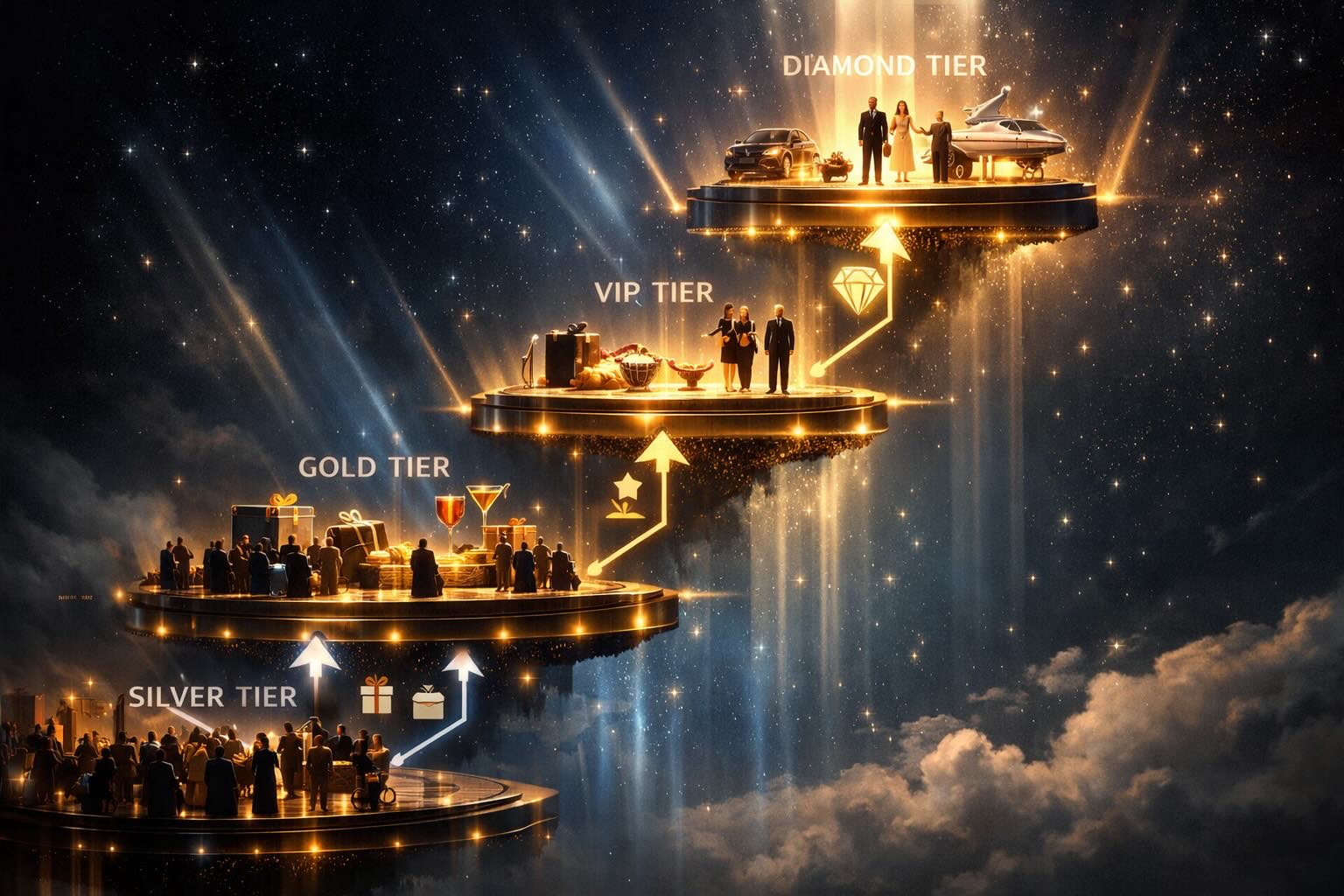
Most loyalty tier structures were built to reward spend. The problem is that spend alone is a poor proxy for the behaviours organisations actually want to drive. When every customer who hits a revenue threshold earns the same status, tiers become entitlements rather than earned distinctions.
Why do loyalty tiers stop working?
A loyalty tier structure stops working when it fails to create meaningful differentiation or drive the behaviours it was designed to incentivise. The most common cause is flat spend-only qualification: a single earn rate with tier thresholds as the only variable. When criteria are this narrow, tier populations grow until status loses its exclusivity.
As outlined in Loyalty Programs: The Complete Guide (Shelper, 2nd Ed., Ch. 8), the Pareto Principle conditions that make tiered programs commercially viable break down when top-tier populations grow too large. Research by Dreze and Nunes (2009) demonstrated that members derive psychological value from status only when their tier is perceived as exclusive. When 25 to 30% of active members hold elite status, the motivational effect collapses.
There is also a structural distinction operators often overlook: the difference between overt and covert tiers. Overt tiers are visible and named. Programs like Qantas Frequent Flyer and Marriott Bonvoy use Gold, Platinum, and Diamond labels that members actively pursue. Covert tiers operate behind the scenes, influencing service prioritisation or offer targeting without the member’s awareness. Both have legitimate uses. The problem arises when programs run overt structures without the commercial discipline to keep them meaningful. The tier label exists; the differentiated experience does not.
Tier inflation results from overly generous earn rates at launch or insufficient modelling of member behaviour over time. The outcome is a top tier that costs the business to maintain but drives no incremental behaviour.
What is engagement-based tier qualification and why does it matter commercially?
Engagement-based tier qualification means members can earn status through a broader set of actions than spend alone. These include product reviews, referrals, data sharing, app check-ins, survey completion, and social engagement. Spend remains part of the equation in most models, but it is not the only variable.
Sephora’s Beauty Insider program is a strong example. Members progress through Rouge, VIB, and Insider tiers not only through purchases but through engagement with the brand’s app, community, and educational content. The result is a tier population that reflects genuine brand affinity. Nike Membership takes a similar approach. Members earn status through workout activity logged in the Nike Run Club and Training Club apps. These qualifying behaviours have no direct revenue attached, yet they correlate strongly with long-term loyalty.
The commercial rationale is clear. As explored in prior Loyalty & Reward Co research on attitudinal loyalty and the psychology behind customer relationships, behavioural and attitudinal commitment are distinct constructs. Engagement-qualified members tend to advocate, refer, and share data. This reduces acquisition costs and increases lifetime value.
Gamification mechanics can stimulate advocacy, referrals, and data sharing beyond purchase frequency. The goal gradient effect explains part of this: members increase effort as they approach a goal. The endowed progress effect adds to it. When members receive a starting advantage at enrolment, they are more likely to complete the journey. Starbucks Rewards applies both principles through its star-based progress tracker, making the path to Gold status feel visible and achievable.
How should you redesign a tier structure?
Loyalty program tier redesign begins with an audit of existing tier populations. If the top tier holds more than 15 to 20% of active members, it is almost certainly inflated. The audit should examine what behaviours the current structure is actually driving. If tier status correlates only with historical spend rather than engagement or retention, the qualification criteria need to change.
Redefining qualification criteria means blending spend signals with engagement signals in a weighted model. A retailer like THE ICONIC with strong app capability may weight non-transactional actions heavily. A hotel group like IHG One Rewards may weight stay frequency more strongly. The principle is consistent: qualify members who generate genuine commercial value across multiple dimensions.
The distinction between status credits and reward currencies is important here. Status credits are non-redeemable and exist only for tier qualification. Qantas Frequent Flyer uses this approach, keeping Status Credits and Points entirely separate. Reward currencies carry balance sheet liability. Non-transactional activities should earn status credits rather than reward points to avoid breakage risk and accounting complexity.
Tier protection mechanics are a critical and often underinvested part of redesign. As noted in Loyalty Programs: The Complete Guide (Ch. 6), the threat of losing tier status is a powerful retention lever rooted in loss aversion. Delta SkyMiles demonstrates this well. Members close to their Medallion Qualification Dollar threshold at year-end consistently show elevated spend in Q4. Tier retention challenges built around a 60-day window apply the same psychology in a more accessible format.
For a broader program overhaul methodology, see the loyalty program redesign how-to guide.
What engagement mechanics actually move the needle?
Progress trackers make tier proximity visible and activate the goal gradient effect. Dunkin’ Rewards and Starbucks Rewards both use progress bars to sustain visit frequency between campaign periods. The mechanic converts an abstract status goal into a concrete, actionable gap.
Milestone rewards are one-time incentives triggered at specific engagement thresholds. These include completing a profile, making a first referral, or reaching a set number of app sessions. Amazon Prime uses milestone mechanics to pull members deeper into its ecosystem. Each new service adopted increases retention probability. Milestone rewards should be non-cash where possible to preserve margin.
Tier challenge mechanics fast-track qualification for members who demonstrate concentrated engagement within a defined window. Singapore Airlines KrisFlyer uses accelerated status challenges to convert high-potential members faster. A member who might take 12 months to qualify organically can convert in 60 days. The behavioural commitment formed during the challenge also makes downgrade less likely.
Gamified non-transactional activities expand participation beyond the register. Reviews, referrals, surveys, and category trials all qualify. Woolworths Everyday Rewards in Australia uses bonus points for completing profile and engagement actions, driving data quality improvements alongside member activation. Each mechanic should map to a specific business outcome. Reviews improve conversion for new customers. Referrals reduce acquisition cost. Surveys provide product intelligence.
Surprise and delight on tier arrival reinforces the perceived value of status at the moment it is most salient. Marriott Bonvoy is known for property-level surprise upgrades when members reach a new tier. This is distinct from a published tier benefit. The unexpected nature of the gesture creates a memorable moment and strengthens emotional association with the new status level.
What are the commercial risks to avoid?
Tier inflation from poorly designed engagement mechanics is the most common failure mode. When engagement actions are rewarded too generously, the top tier expands and exclusivity is lost. Modelling tier population outcomes before launch is the only reliable fix.
Breakage mismanagement occurs when engagement credits accumulate without converting to behaviour change. Programs should monitor accumulation rates and intervene through reminder communications or expiry mechanics before credits represent a liability without a return.
Siloed design is a structural risk in most organisations. Marketing designs tier structures. Finance does not model them. Operations cannot execute them. Commercial modelling of tier economics must happen before go-live. See the loyalty program redesign how-to guide for a full methodology.
The Bottom Line
A tier that too many members can reach is no longer a tier. It is a label, and labels do not change behaviour. Engagement-based qualification extends the commercial value of tier structures by rewarding the full range of behaviours that generate business value. When combined with visible progress mechanics, loss aversion triggers, and genuine benefit differentiation, a redesigned tier structure can improve retention, data quality, acquisition efficiency, and lifetime value simultaneously.
If your tier structure is due for a redesign, Loyalty & Reward Co’s loyalty services team works with brands globally to design and implement commercially sound loyalty programs. For the academic and strategic frameworks underpinning tier design, see Loyalty Programs: The Complete Guide (Shelper, 2nd Ed.).
External References
Loyalty Programs: The Complete Guide, Shelper, 2nd Ed. Loyalty & Reward Co.
Dreze, X. & Nunes, J.C. (2009). Feeling Superior: The Impact of Loyalty Program Structure on Consumers’ Perceptions of Status. Journal of Consumer Research, 35(6), 890-905.
McKinsey & Company. (2023). The value of getting personalization right or wrong is multiplying. mckinsey.com