Banana Republic Rewards stands out as one of the most comprehensive offerings in the fashion retail space. From special birthday perks to exclusive shopping events, this program offers more than your typical points offering.
If you’re considering applying for a Banana Republic credit card or simply want to maximize your shopping rewards, this article provides a comprehensive overview of how the program operates, covering everything from earning points to achieving Icon status.
Understanding Banana Republic rewards basics
The Banana Republic program is a straightforward points-based system where members earn points for their purchases. It is also part of an integrated program that combines both credit card and loyalty benefits across all Gap Inc. brands19. This unified approach is particularly beneficial for shoppers who frequent multiple Gap Inc. stores such as Old Navy, Athleta and Intermix.
Key program benefits overview
We’ve identified several standout features that make this program particularly valuable:
- Double rewards redemption opportunities
- Quarterly cross-brand purchase bonuses
- Free shipping on qualifying orders
- Birthday rewards
- Basic alterations for Icon members on BR merchandise19
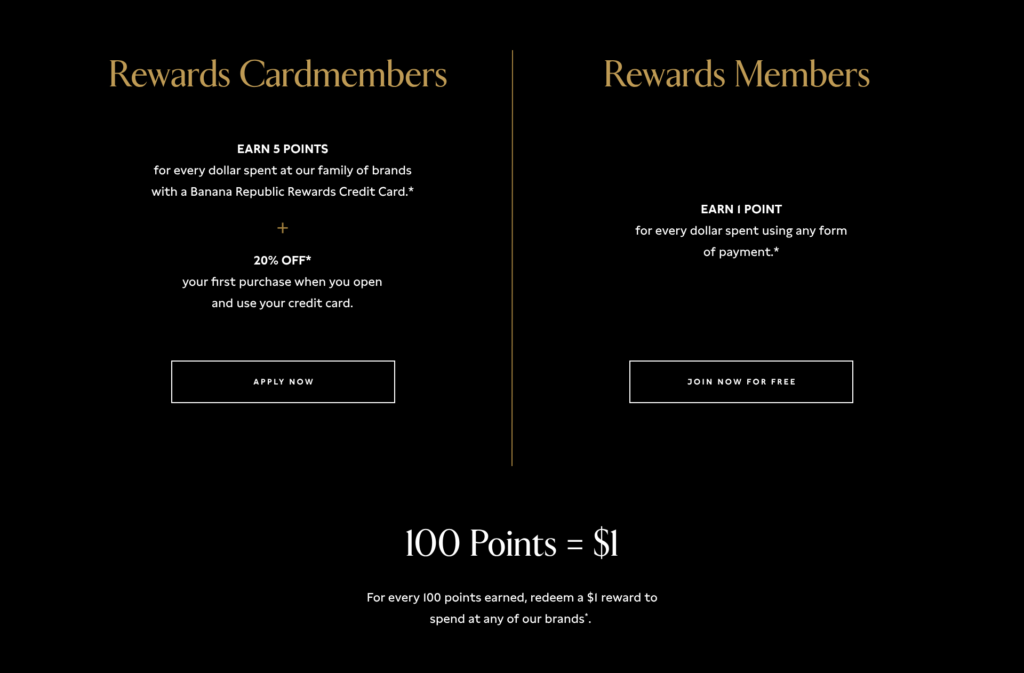
Credit card members will earn even more, with the program offering a bonus 5 points for every $1 spent at Gap Inc. brands and 1 point per $1 spent at any other establishment. Points can then be redeemed against future purchases, with each point valuing at 1 cent per point7.
This structure effectively balances accessibility for casual shoppers while offering substantial benefits for loyal customers. The program has proven particularly successful, with more than 37 million combined Cardmembers and Rewards members participating in the loyalty program20.
How to join Banana Republic rewards
The process of joining Banana Republic’s rewards program is straightforward. To get the most out of your experience, we recommend considering your shopping habits before choosing between the regular membership and credit card options.
Sign up process walkthrough
Joining the regular rewards program is simple and free. Here’s how to get started:
- Visit the Banana Republic website
- Choose between email or text signup
- Provide your contact information
- Accept the terms and conditions
- Confirm your account
Note: By signing up for text notifications, you’ll receive automated personalized messages like cart reminders and marketing updates21.
Choosing between regular and credit card membership
We advise shoppers to carefully evaluate both membership options. The Banana Republic Rewards Mastercard® offers significant advantages:
- 20% discount on your first Banana Republic purchase (must be used within 14 days)7
- 5 points per $1 spent on purchases7
- Opportunity to reach Icon status with 5,000 points in a calendar year7
- Access to quarterly bonus points and more
Account setup and activation
After choosing your preferred membership type, the account activation process begins. For credit card members, you’ll need to wait for your physical card to arrive. Eligible cardholders will also have the opportunity to unlock Icon status (upon earning 5,000 points). Icon status members receive more exclusive benefits including key highlights such as:
- Quarterly bonuses of 500 points7
- Free 2-3 day shipping on purchases over $507
- Complimentary basic alterations on qualifying Banana Republic items7
We recommend setting up your online account immediately after joining to track your points and access member-exclusive offers. Your membership becomes active right away, allowing you to start earning points on your very first purchase.
Earning points with regular membership
Let’s explore how to maximize your earnings with the Banana Republic rewards program.
Points earned via purchase
The basic earning structure is straightforward. Regular rewards members earn 1 point for every $1 spent across all Gap Inc. brands6 instore and online. Online shoppers will also access the added benefit of free shipping on all orders above $50.
Special promotions and bonus points
The program also offers various opportunities to boost your earnings through special promotions. Our analysis shows these valuable earning opportunities:
- Quarterly cross-brand purchase bonuses6
- Dynamic in-season promotions
- Birthday bonus points
- Double reward redemption days for Icon members6
One unique feature we appreciate is the ability to donate points through the “Do Good” initiative4. This option allows members to support charitable causes while shopping, adding a meaningful dimension to the rewards program.
For those seeking to maximize their earnings, we suggest timing your purchases during bonus point events and cross-brand promotions. Icon members especially benefit from exclusive earning opportunities, including double rewards redemption days6.
Remember that points earned through regular membership can be combined with other promotional offers, creating opportunities for substantial savings. Based on our experience, members who strategically plan their purchases during these special events often see their points accumulate much faster.
Credit card rewards and benefits
Our analysis of the Banana Republic credit card reveals some compelling benefits that set it apart from standard retail cards.

Credit card points multipliers
The earning structure stands out with its generous multipliers. As previously mentioned, cardholders earn 5 points for every $1 spent at Banana Republic and other Gap Inc. brands7. This translates to a 5% return on your shopping at these stores. For purchases outside Gap Inc. brands, you’ll earn 1 point per $1 spent4.
Extra perks and privileges
Beyond the basic points structure, the card offers notable benefits:
- 20% discount on your first purchase (must be used within 14 days)7
- Free fast shipping on orders over $504
- Early access to select sales
- Digital wallet integration with Apple Pay® and Google Pay®4
- No annual fee4
Navigating reward tiers and status
The three-tier structure makes Banana Republic rewards somewhat unique in retail loyalty. Understanding these tiers can help maximize your shopping benefits.
Core member benefits
The entry-level Core membership requires no minimum spending and is free to join. Besides the basic earning rate of 1 point per dollar spent, Core members receive:
- Quarterly cross-brand purchase bonuses
- Birthday surprise rewards
- Free 3-5 day shipping on orders over $503
Luxury member advantages
Moving up to the Enthusiast level happens when you reach $500-$999 in annual spending3. In addition to Core benefits, Enthusiast members enjoy:
- Exclusive member-only offers
- Enhanced shipping options
- Special cardmember privileges (for credit card holders)
Icon status perks
The pinnacle of the program is Icon status, which members can achieve through two paths:
- Spending $1,000+ annually
- Earning 5,000 points in a calendar year7
Once you reach Icon status, you’ll unlock premium benefits:
- Quarterly bonus of 500 points7
- Free 2-3 day shipping on purchases over $503
- Free basic alterations on qualifying Banana Republic items7
- Double Rewards Redemption Days3
- Choose Your Own Sale Day privilege7
What makes this program particularly valuable is its flexible point redemption structure. Members can redeem rewards in $1 (100 point) increments3, whereas previously, members were required to redeem in 500-point blocks. This change makes the program more accessible and allows for quicker reward utilization.
The Banana Republic rewards structure offers substantial value at each tier level. The progression from Core to Icon status provides increasingly valuable benefits while maintaining achievable spending thresholds.
For shoppers who frequently visit Banana Republic and other Gap Inc. brands, reaching higher tiers becomes notably easier since purchases across all affiliated brands count toward status qualification3. This cross-brand integration represents one of the program’s strongest features.
Rewards summary
The path to maximizing rewards involves reaching Icon status to access it’s many benefits, with key offers including:
- Quarterly bonus of 500 points7
- Free basic alterations on qualifying Banana Republic purchases7
- Create Your Own Sale Day with 15% off8
The card carries a variable annual percentage rate (APR) of 33.99%4, making it crucial to pay your balance in full each month.
For shoppers who frequently visit Banana Republic and other Gap Inc. brands, this card offers substantial value through its multipliers and exclusive perks. Nonetheless, it’s essential to strategically use the card to maximize benefits while avoiding interest charges.
Redeeming your rewards
Understanding how to maximize your reward redemptions can significantly enhance your shopping experience.
Converting points to rewards
The point conversion system follows a straightforward structure. For every 1,000 points earned, you receive a $10 reward certificate1. This means each point essentially equals one cent in reward value. This makes it easier to track the actual value of your earnings.
Here’s the basic conversion breakdown:
- Regular rewards conversion: 1,000 points = $10
- Minimum redemption: $5 value
- Maximum single reward: $50 value
- Points have no cash value9
Where to use rewards
Your Banana Republic rewards offers flexibility in terms of redemption locations. These rewards can be used:
- At any Gap Inc. brand store (except BR Home)
- Through online shopping platforms
- Via phone orders
- During sale events
To redeem in stores, present your rewards at checkout. For online shopping, sign into your account and apply the reward code during checkout9. You can combine up to three reward certificates for in-store purchases and five for online orders1.
Expiration and limitations
Points and rewards do come with some important time restrictions. Points expire after 24 months of account inactivity1. Likewise, reward certificates have specific expiration dates printed on them.
Key limitations to remember:
- Rewards cannot be used for:
- Gift card purchases
- Taxes or state fees
- Shipping charges
- Charitable donations
- Gift wrapping services9
When returning items purchased with rewards, the dollar value is converted back to points and credited to your account within two billing cycles1. The value of your reward will be prorated across purchased items and shown on your receipt9.
For optimal value, we recommend:
- Tracking your point expiration dates
- Combining rewards with promotional offers
- Using rewards before their expiration
- Keeping receipts for potential returns
Remember that while points cannot be exchanged for cash or credit, they can be combined with one promotional offer per purchase1.
Digital tools and features
Let’s explore the digital tools that can make managing your Banana Republic rewards easier than ever. The brand has embraced modern technology to enhance the shopping experience through various digital platforms.
Mobile app capabilities
The Banana Republic mobile app serves as your personal shopping assistant, offering a curated world of style at your fingertips10. The app provides several key features:
- Express checkout options
- Push notifications for exclusive offers
- New arrival alerts
- Search and filter tools
- Direct access to rewards and promotions
- Customer support integration
- Personalized shopping recommendations
The app streamlines both shopping and rewards management, making it simpler to track your points and redeem benefits10.
Online account management
Managing your Banana Republic rewards account online offers comprehensive control over your shopping experience. The platform allows you to:
- Track points and rewards balances
- View purchase history
- Access exclusive member offers
- Update personal preferences
- Manage communication settings
The online platform also includes personalized shopping features that customize your experience based on your preferences and shopping history11.
Digital wallet integration
Banana Republic has introduced digital wallet compatibility to enhance payment convenience. The program now supports both Apple Pay® and Google Pay®4, offering several advantages:
- Seamless checkout process
- Enhanced payment security
- Quick access to rewards
- Integrated loyalty tracking
- Contactless payment options
The digital wallet integration extends beyond mere payment processing. 51% of consumers express interest in using digital wallets for additional functions like loyalty program management and accessing exclusive promotions12.
These digital tools become even more valuable for Icons members, as they can immediately access their benefits and track progression toward quarterly bonuses13.
The platform incorporates AI-powered chat capabilities, allowing members to receive instant responses to questions about their rewards and benefits13.
Special perks and exclusive offers
We’ve identified several exclusive perks that make the Banana Republic rewards program stand out in the retail landscape.
Birthday rewards
Banana Republic celebrates your special day with exclusive birthday rewards14. These birthday perks include:
- Special bonus point offers
- Exclusive birthday discount
- Extended redemption period
- Personalized birthday messages
- Bonus rewards for Icon members
Member-only events
Throughout the year, members gain access to exclusive shopping events and promotions. One of the most valuable perks is the Friends and Family sale, where cardmembers receive early access2. These events typically feature:
- Stackable discount opportunities
- Combined savings up to 66.25% off
- Special card-member exclusive codes
- Mobile app-specific promotions
- Additional cashback opportunities
These events provide substantial savings opportunities beyond regular promotional offers. For instance, cardmembers can occasionally stack multiple discount codes, such as combining the Friends and Family discount with email sign-up offers2.
Early access benefits
The early access privileges represent one of the most valuable aspects of membership. Credit card holders receive priority access to select sales4, ensuring they never miss out on popular items.
Beyond standard early access, members receive:
- First access to new collections
- Preview opportunities for upcoming sales
- Extended shopping windows for major promotions
- Priority notification of special events
For Icon status members, these benefits become even more valuable. They receive enhanced early access privileges and exclusive shopping windows before other membership tiers. Hence, the combination of early access and member-only events creates a comprehensive suite of benefits that rewards loyal shoppers.
The program occasionally offers special promotions for credit card holders, such as an additional 30% off full-priced items16.
These exclusive perks and offers ensures that casual shoppers and dedicated customers alike find value in the program, while providing additional incentives to reach higher membership tiers.
What do members say?
After reviewing various testimonials from Banana Republic Rewards members, we’ve compiled insights reflecting real user experiences with the program.
Positive Feedback:
- One member appreciates the high earning rate at brand stores: “Earning 5 points per dollar at Banana Republic and its sister brands makes accumulating rewards quick and easy.” 22
- Another user highlights the Luxe status perks: “Achieving Luxe status has been rewarding with benefits like free shipping and exclusive sales access.” 23
- A satisfied cardholder notes the seamless integration across brands: “Being able to earn and redeem rewards at multiple stores like Gap and Old Navy adds great flexibility.” 22
Negative Feedback:
- Some members express concerns about the high APR: “The variable purchase APR is steep; carrying a balance can quickly outweigh the rewards benefits.” 24
- Others mention limited redemption options: “Rewards can only be redeemed for purchases at Gap Inc. brands, limiting flexibility compared to other cashback cards.” 23
- Additionally, the low earning rate outside brand stores has been a point of contention: “Earning only 1 point per dollar on non-brand purchases makes it less appealing for everyday spending.” 25
The Banana Republic Rewards Program offers significant benefits for loyal shoppers of Gap Inc. brands, especially those who can achieve Luxe or Icon status.
How does it rate against Loyalty & Reward Co’s Essential Eight Principles?
As experts in the global loyalty consulting industry, Loyalty & Reward Co have identified Essential Eight® Principles that feature in all best-practice loyalty programs. We use them to guide the program design or audit process to identify areas for improvement.
Let’s see how Banana Republic Rewards rates:
Is it Simple?
The program demonstrates a straightforward simplicity in its core structure. Following customer feedback, Banana Republic streamlined their point system to allow redemptions in $1 (100-point) increments, rather than the previous 500-point threshold5. This modification makes the program notably more accessible for members.
The use of digital tools such as chatbots, digital wallet and online account management have also helped to simplify the UX experience, enabling members to navigate the program queries and concerns easily.
Is it Valuable?
Looking at value proposition overall, the program delivers many ways to access value. Naturally, the most substantial benefits are available for credit card members and high-status members such as Luxe and Icon. Credit card members earn 5 points per dollar at Gap Inc. brands7, whereas regular members earn 1 point per dollar17. Furthermore, the program includes practical benefits like free shipping on orders over $50 and complimentary alterations for Icon members17.
However, when compared to the wider credit card programs available in the market, the BR Mastercard value proposition falls short in categories such as earn and burn flexibility, and having a higher APR. Unless members are an avid BR or Gap Inc. shopper, they may find other credit card offerings may potentially provide greater value.
Is it Stimulating?
In terms of engagement, the program effectively motivates ongoing participation. The three-tier structure (Core, Enthusiast, and Icon) creates clear progression paths17. Additionally, quarterly cross-brand purchase bonuses and double reward redemption days keep members actively engaged. The ability to track points progression also visually stimulates members to continue towards their next goal or achievement.
Is it Emotional?
The emotional connection is fostered most notably through the “Do Good” component, which allows members to donate points to five different charitable funds6. This initiative aligns with growing consumer interest in brands that demonstrate social responsibility18.
The Banana Republic program structure allows members to enjoy various monetary rewards; however, there is potential to enhance the program by adding more experiential benefits that can create a stronger emotional bond with customers. This could include unexpected surprises or unique, one-of-a-kind experiences.
Is it Complementary?
From our analysis, the program excels in complementing the overall shopping experience. The integration across Gap Inc. brands creates a unified experience, with over 37 million members benefiting from this cross-brand approach17. This seamless integration also enhances the overall value proposition.
Is it Differentiating?
The Banana Republic program ranks moderately in differentiation. Credit card programs are very common and competitive in the US market, with the Banana Republic offering providing a valuable but relatively standard offering in terms of points earn and redemption.
However, unlike other brands, Banana Republic has the unique advantage of uniting with its sister brands. Consequently, the Banana Republic program distinguishes itself through its extensive integration across other Gap Inc. brands while still offering brand-specific benefits. For Banana Republic specifically, unique features include:
- Free basic alterations for Icon members
- Style Cash conversion options
- Exclusive community experiences
Our analysis concludes there is still opportunity for Banana Republic to explore more unique reward offerings, potentially through their styling services to create memorable experiences for top tier members.
Is it Cost-Effective?
The program demonstrates strong cost-effectiveness through its tiered structure. By starting members at the free Core level and providing enhanced benefits at higher tiers, it creates a balanced value exchange. The recent streamlining of point redemption5 has made the program more efficient without compromising its value.
Is it Evolving?
Perhaps most impressively, the program shows continuous evolution based on customer feedback and market trends. Recent improvements include:
- Simplified point redemption structure5
- Enhanced digital integration with mobile apps
- Introduction of the “Do Good” charitable component6
- Expanded cross-brand benefits
The program has shown remarkable adaptability, with Gap Inc. enrolling more than 19 million new customers in less than 12 months after relaunching their loyalty program6. This growth demonstrates the program’s ability to evolve with changing consumer preferences.
Through our expert analysis, we observe that the Banana Republic rewards program effectively meets most of the Essential Eight Principles. The program’s strength lies in its balance of simplicity with comprehensive benefits, although there’s always room for further refinement in the digital experience and emotional appeal.
The integration of sustainability initiatives and social responsibility components18positions the program well for future growth, as these elements increasingly influence consumer loyalty. Coupled with the program’s demonstrated willingness to evolve based on member feedback, these factors suggest a strong foundation for continued success.
Conclusion
Banana Republic rewards stands out as one of retail’s most comprehensive loyalty programs. Through our analysis, we’ve seen how this program excels by combining straightforward point earning with valuable perks across all Gap Inc. brands.
The three-tier structure rewards members at every level while offering compelling reasons to reach Icon status. Credit card holders particularly benefit from accelerated point earning and exclusive perks, though regular members still enjoy significant value through free shipping, birthday rewards, and special events.
Whether you’re a casual shopper or dedicated fashion enthusiast, this rewards program offers substantial value. Members who strategically time their purchases during bonus events and take advantage of cross-brand shopping opportunities will find their rewards accumulating quickly.
Our review confirms that Banana Republic rewards delivers on its promise of meaningful benefits while maintaining program simplicity.
Loyalty & Reward Co’s Essential Eight Principles™
Want to know more about the Essential Eight™? Read our whitepaper.
Do Loyalty Programs Work?
Looking for examples of best-practice loyalty programs from around the world that have delivered outstanding results? Check out our ‘Do Loyalty Programs Work?’ series.
References
[1] – https://bananarepublic.gap.com/Asset_Archive/BRWeb/content/0009/730/095/assets/legal.html
[2] – https://www.reddit.com/r/frugalmalefashion/comments/fgf6mr/banana_republic_friends_and_family_early_access/
[3] – https://www.gapinc.com/de-de/articles/2021/07/gap-inc-announces-launch-of-new-integrated-rewards
[4] – https://cards.barclaycardus.com/banking/cards/banana-republic-rewards-mastercard/
[5] – https://www.forbes.com/sites/sharonedelson/2021/07/22/gap-inc-deepens-connection-to-consumers-with-new-loyalty-program/
[6] – https://www.gapinc.com/en-us/articles/2021/07/gap-inc-announces-launch-of-new-integrated-rewards
[7] – https://www.nerdwallet.com/article/credit-cards/banana-republic-credit-card
[8] – https://wallethub.com/edu/cc/banana-republic-credit-card-review/25980
[9] – https://www.gap.com/Asset_Archive/AllBrands/Loyalty/terms/terms-conditions_090631.html
[10] – https://apps.apple.com/us/app/banana-republic-shop-apparel/id342797197
[11] – https://bananarepublic.gap.com/customerService/info.do?cid=80745
[12] – https://lisnr.com/resources/blog/digital-wallet-and-retail-loyalty-integration/
[13] – https://www.retaildive.com/ex/mobilecommercedaily/banana-republic-factory-pilots-mobile-loyalty-chat-to-enhance-in-store-shopping
[14] – https://www.shopwestcountycenter.com/store/banana_republic/deal/blt0c055571c26a8bad
[15] – https://bananarepublic.gap.com/browse/info.do?cid=1066225
[16] – https://www.instagram.com/genevacommons/p/DAqubeSv6ml/
[17] – https://loyaltyrewardco.com/gap-inc-bridging-the-gap-between-transactional-and-emotional-loyalty/
[18] – https://thebrandhopper.com/2023/04/26/fashion-forward-a-deep-dive-into-the-marketing-strategies-of-banana-republic/
[19] – https://www.gapinc.com/it-it/articles/2021/07/gap-inc-announces-launch-of-new-integrated-rewards
[20] – https://sourcingjournal.com/denim/denim-brands/gap-inc-intergrated-rewards-program-do-good-old-navy-athleta-banana-republic-292482/
[21] – https://bananarepublic.gap.com/customerService/info.do?cid=1098875
[22] – https://www.nerdwallet.com/article/credit-cards/banana-republic-credit-card
[23] – https://www.mybanktracker.com/credit-cards/expert-reviews/banana-republic-credit-card-review-254014
[24] – https://www.gobankingrates.com/credit-cards/retail/banana-republic-credit-card-review/
[25] – https://www.forbes.com/advisor/credit-cards/banana-republic-credit-card