Most consumers now belong to multiple loyalty programs. Canadians are active in an average of 15 programs, according to the Bond Loyalty Report, and Australians in an average of 10.1, according to The Point of Loyalty’s For Love or Money™ 2026 study. Across Europe, Mando and YouGov found that 63 per cent of adults belong to at least one program, from 89 per cent in Finland to 24 per cent in Turkey. New programs launch, and existing ones relaunch, in almost every industry every year.
A loyalty program is a structured program that rewards and recognises registered members for repeat transactional and non-transactional behaviour. At Loyalty & Reward Co we use use a more practical definition: a desirable behaviour stimulation program. A brand that knows which behaviours it wants from members, from first purchase through to referral, can design the program to reward those behaviours and then measure whether the incentives are working.
Brands run loyalty programs because, when designed well, they are able to drive incremental acquisition, spend, non-transactional-engagement, retention, cost-savings, and advocacy. They also require investment, may create balance sheet liabilities, risk being copied by competitors, and require deep expertise to get right.
Loyalty programs as commercial assets
The financial value of a loyalty program is easy to underestimate, but the pandemic made the value of some major loyalty programs quite visible. With their fleets grounded, the three largest US airlines raised US$25.8 billion in debt secured against their loyalty programs. United raised US$6.8 billion against MileagePlus in July 2020, Delta raised US$9 billion against SkyMiles in September 2020, and American raised US$10 billion against AAdvantage in March 2021. Lenders wanted the loyalty programs as security because their cash flows were the most stable part of the business.
In a June 2020 filing with the US Securities and Exchange Commission, American Airlines disclosed that the most recent third-party appraisal valued AAdvantage at between US$19.5 billion and US$31.5 billion. Qantas reports its loyalty business as a separate segment. In the 2026 financial year, Qantas Loyalty lifted underlying earnings before interest and tax (EBIT) by 12 per cent to A$625 million, while by comparison group underlying profit before tax fell by A$330 million under higher fuel costs and Middle East disruption (Travel Weekly, 2026). Qantas is targeting A$800 million to A$1 billion in loyalty earnings by 2030.
The pattern extends well beyond airlines. In Japan, Rakuten has built retail, banking, mobile, and travel businesses around a single currency, Rakuten Point, issuing around 650 billion points in 2023 alone to a membership base of more than 100 million. Across retail, hotels, banking, and fuel, some loyalty programs have evolved from a perceived marketing cost to an astonishingly valuable strategic asset.
The collection and utilisation of data has added to value a loyalty program can generate. Rising media costs inside the walled gardens of big tech platforms (such as Facebook, Google and Amazon), tighter privacy laws, and the spread of artificial intelligence (AI) have made the zero- and first-party data a loyalty program can collect (accompanied by the all-important member consent) one of the most valuable assets a brand can own. A growing number of programs are justified as much by the data relationship they create as by the sales they drive.
Zero-party data is information a member chooses to share, such as preferences and intentions. First-party data is what the brand observes directly, such as transactions and visits.
Opportunities a loyalty program generates
The primary ambition of a loyalty program should be to deeper engagement between members and a brand. This typically manifests as incremental acquisition, spend, non-transactional engagement, retention, cost-savings, and advocacy. In a global survey by the Loyalty Science Lab at Old Dominion University, 68 per cent of respondents said loyalty programs influence where they buy, 72 per cent said programs lead them to buy more, 76 per cent said programs make them stay longer, and 75 per cent said programs make them feel more favourable towards a brand (Liu-Thompkins and Taheran, 2023). These are self-reported figures from a single survey, and transactional behaviour can tell a different story, but they do clearly highlight the potential of a best-practice program.
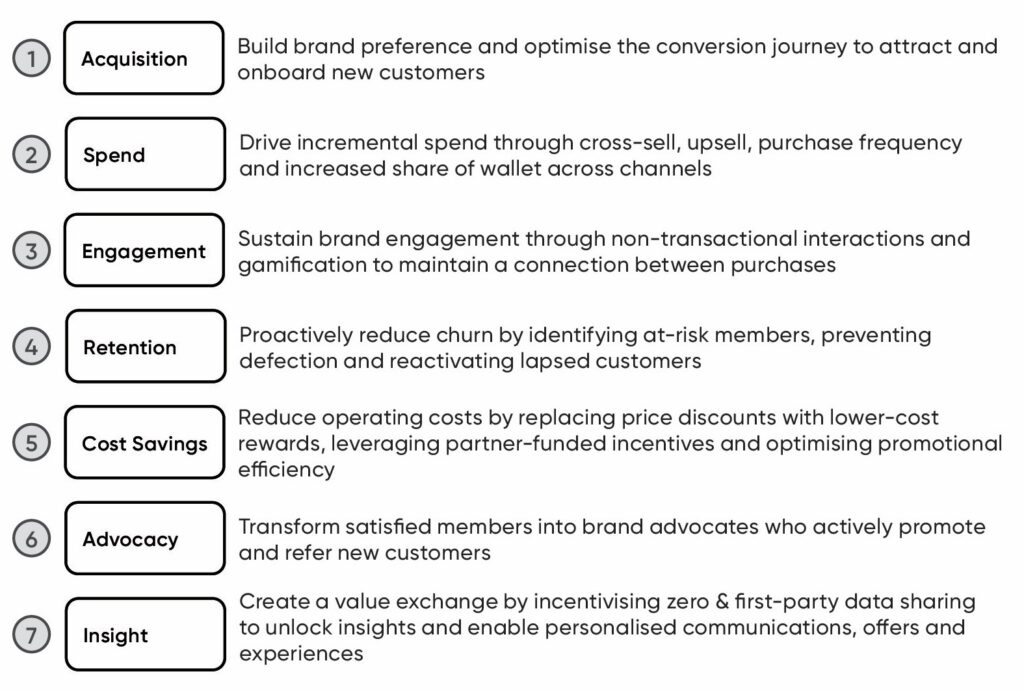
Loyalty & Reward Co group the benefits a well-designed program can deliver into our Seven Core Business Outcomes™ model:
- Acquisition: the promise of value, and referral rewards offered through existing members, can persuade consumers to choose one brand over another. Joining also gives the brand a member database it can market to at lower cost than paid media
- Spend: incentives can lift basket size, visit frequency, purchases in new categories, and trading up to higher-priced items. The goal is for members to consolidate their category spend with the brand at the expense of competitors
- Engagement: members do not need to buy all the time. Non-transactional activity, such as content, games, or preference updates, keeps the brand in the member’s consideration set between purchases and often prompts members to share more data
- Retention: tracking both transactional and non-transactional activity reveals early signs of disengagement, so the brand can identify the cause and act before the member leaves. Program data also shows what each member is worth, which helps the brand decide how much to spend on keeping them
- Cost savings: a program can replace blanket discounting with targeted rewards, direct promotional budgets towards incremental sales, and draw on supplier or partner funding to offset its costs or create new margin streams
- Advocacy: recognition and rewards build emotional attachment that members express through word of mouth or through formal referral mechanics
- Insight: a loyalty program is one of the few settings where customers volunteer their identity at the point of sale in exchange for value. That data can inform decisions across range, pricing, promotions, and stores, and powers more relevant communications and offers
Partners add another source of value. Coalition earn partners, co-brand credit card issuers, and retail brands pay to reach an engaged member base without building a program of their own.
Challenges a loyalty program must overcome
The challenges of running a loyalty program are substantial:
- Expense: a program needs specialists to design, implement, and run it, technology that is bought, built, or leased, and investment in marketing, training, legal, analytics, accounting, and customer service. And then there is the largest cost of all being the rewards and benefits themselves
- Delivering meaningful value: members join because they expect value and stay because they keep receiving it. Some brands cannot or will not fund enough value for most of their members to stay engaged
- Reward liability and breakage: points or cashback issued but not yet redeemed is a liability. Operators must forecast redemption, manage the gap between issue and redemption, and estimate breakage, the share of currency that will never be redeemed, in line with accounting standards. At scale, this becomes a material item on the balance sheet
- Devaluation and member backlash: the operator sets the program’s value and can reduce it, sometimes for good reason. Engaged members notice quickly, commentators track every change, and the high-value members a program most wants to keep are the ones most likely to defect. In September 2023, Delta announced sharp increases to SkyMiles status thresholds and, after a member backlash, scaled the changes back within five weeks after determining the potential financial impact of losing their most valuable members
- Data, privacy, and regulatory exposure: the data that makes a program valuable also creates obligations. Programs must comply with privacy and consumer protection law in every market where they operate, and regulators have shown they will investigate and fine operators over how member data is collected, used, and shared
- Disengagement: keeping members active is hard, even for large, well-funded programs. Many databases hold large numbers of members who no longer engage at all
- Cannibalisation and margin dilution: a poorly designed program risks rewarding purchases that would have happened anyway, turning full-margin sales into discounted ones. Measuring incremental value accurately takes expertise many companies do not have in-house
- Competition: competitors launch, copy, and improve. A program that stands still loses relevance
Members face their own frustrations, and each becomes a problem for the brand. Consumers report rewards that feel out of reach, too many programs competing for their attention, a flood of emails and push notifications that lack relevance, and uncertainty about how their data is being used. A program that adds to that noise gives members plenty of reasons to disengage, and a disengaged member is incredibly hard to win back.
Rising expectations: the Empowered Customer Mandate™
Consumer expectations keep moving, and AI and agentic commerce are moving them faster. Many brands struggle to define what the modern consumer expects, let alone deliver it. Loyalty & Reward Co’s Empowered Customer Mandate™ sets out nine expectations that shape how consumers judge the brands they choose to engage with:
- Protect my data
- Know my context
- Remember me
- Make it effortless
- Anticipate my needs
- Be real
- Stand for something
- Prove I can trust you
- Make my loyalty worth it
It is important to recognise that consumers do not just compare a loyalty program against a brand’s direct competitors offering. Often they will compare it against their favourite loyalty program which may be in a completely different industry. A member whose grocery program feels less relevant than their preferred frequent flyer program or cosmetics brand loyalty program will be less likely to engage.
In Loyalty & Reward Co’s experience, most loyalty program operators overestimate how well they meet the expectations detailed in the Empowered Customer Mandate™. Antavo’s Global Customer Loyalty Report 2026 found a 26 percentage point gap between the share of operators who believe their program makes members feel valued and the share of members who report feeling valued.
The full potential of a loyalty program
A best-practice loyalty program successfully builds a long-term, data-rich relationship with members that benefits both sides and grows in value over the member lifecycle. Members receive recognition, relevance, and value that improves over time. The brand gains a commercial asset that provides a sustainable competitive advantage, built on consented data, repeat revenue, and a direct line of communication to each member. When that combination harmonises, the outcome it produces explains why lenders, investors, and boards now value some loyalty programs as highly as the rest of the business.
Globaly, few programs reach that level, because it is hard (and way harder than most leaders realise). The benefits that a loyalty program generates depend on being able to provide meaningful rewards, a refined design that is grounded in consumer psychology, exceptional technology that is properly integrated and configured, commercial models that can accurately measure incrementality, and an endless obsession with optimisation and evolution. Rising consumer expectations, driven in part by AI and agentic commerce, will raise the bar further. But, those brands that invest and are guided by a superior strategy will win big, while those that don’t risk being left behind.
Loyalty & Reward Co are a the world’s only global pure-play loyalty consultancy. We design, implement, and evolve best-practice loyalty programs for major brands and help them measure the positive return so they can gain confidence in further investment.
If you liked this article, you will love Loyalty Programs: The Complete Guide (3rd Edition).