There is a feeling that separates the most loyal customers of a brand from everyone else. It is not satisfaction or habit, but the feeling that something belongs to them.
Psychological ownership is the subjective sense that a target is “MINE,” independent of legal title. When loyalty program members feel they own their tier status, their points balance their assigned seat, or even the brand, they can become significantly more loyal. Not because of the rational value of rewards, but because leaving the program or the brand means losing part of themselves.
Loyalty & Reward Co explored eight academic studies and systematic reviews to explain what psychological ownership is, why it matters for loyalty programs, and how to design for it.
What is psychological ownership?
First formalised by Pierce, Kostova and Dirks (2001) in an organisational context and later extended to consumer settings by Peck and colleagues, psychological ownership is both a cognitive state (beliefs and awareness about ownership) and an affective state (emotional attachment to the target). It is conceptually related to but distinct from the endowment effect. Psychological ownership is the underlying mechanism, and the endowment effect is one of its behavioural consequences.
When a person exercises control over a target or goal, invests themselves in it, or develops intimate knowledge of it, the target becomes fused with their self-concept. It is no longer experienced as “something I use” but as “part of who I am.”
This creates four measurable consequences:
- Overvaluation: The target is worth more subjectively than its objective market value.
- Loss resistance: Relinquishing the target is experienced as a loss of self, amplifying loss aversion.
- Stewardship: The person takes responsibility for the target, extending loyalty from the object to the brand that produced it.
- Citizenship behaviour: The person advocates, contributes, and protects the brand as they would something they own.
The scale of the evidence
The evidence base for psychological ownership in loyalty contexts is substantial and growing. it is one of the most exciting areas of academic research at present, and hugely important for the future of loyalty program evolution.
Kim, Li and So (2024) conducted the most comprehensive bibliometric analysis of psychological ownership in business research, examining 541 published articles from 1995 to 2022. Their finding was unambiguous, determingin that customer loyalty is one of the most consistently documented outcomes of psychological ownership across the entire published field. This is not a single-study conclusion, but a field-wide consensus.
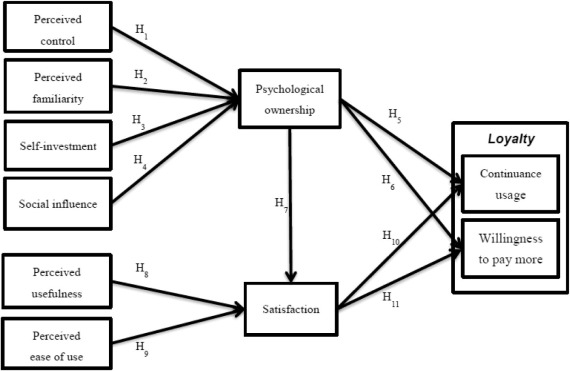
Yoon, Peck and Shu (2025) tested the construct directly in a hospitality loyalty context across four studies: analysis of 14,689 hotel reviews, a field experiment with 82 participants, and two lab simulations with 1,002 participants. Their central finding is critical for loyalty program designers, establishing that psychological ownership increases loyalty independently of satisfaction. Satisfaction is necessary, but it is not sufficient. Ownership is an additional, independent pathway.
This distinction matters enormously. Many brands obsessively focus on measuring and driving satisfaction under the assumption that it drives retention, but the research says otherwise. A member can be satisfied and still leave. While generating satisfaction is still very important, smart brands are investing in generating member feelings of ownership as they understand this delivers a much stronger retention effect.
The endowment effect: the science behind ownership
The behavioural consequence of psychological ownership that loyalty professionals will recognise most readily is the endowment effect.
In the famous coffee mug experiment, Kahneman, Knetsch and Thaler (1991) gave university students identical coffee mugs. Sellers who owned a mug demanded an average of $7.12 to part with it. Buyers who did not own one offered an average of $2.87. While the same mug, they demonstrated that ownership alone inflated perceived value by approximately 2.5 times. The concept was first identified by Thaler (1980), who documented the gap between what people are willing to pay for something and what they demand to give it up.
Applied to loyalty programs, Duque (2017) showed that points and tier benefits create an endowment the member fears losing. Once a consumer has started accumulating points, switching to a different provider implies surrendering owned progress. That loss feels approximately twice as large as the equivalent gain elsewhere.
This is part of the driving force behind “mileage runs,” why points balances create stickiness even when the objective value is modest, and why tier demotion triggers emotional reactions that far exceed the rational value of the lost benefits.
The three ownership triggers
Yoon, Peck and Shu (2025) tested three empirically validated pathways that generate psychological ownership. All three independently increase ownership and loyalty, and are additive when combined.
1. Control: give members choice
Members who choose their room, select their seat, or configure their reward feel agency over the outcome. That agency creates the first pillar of ownership, and it costs nothing to offer.
In the hotel field experiment, guests who were given the ability to choose their room at check-in showed significantly higher psychological ownership of the room and, as a consequence, higher loyalty to the hotel brand. The intervention was simple, low-cost, and effective.
For loyalty programs, this means configurable benefit mixes, reward category selection, and any mechanic that gives the member genuine choice over how they experience the program.
2. Investment of self: invite personalisation
When members customise their experience, they invest themselves into the object. They rearrange, name, configure, and create. That investment becomes psychological ownership far stronger than any points transaction.
Profile completion, preference setting, community contribution, and onboarding activities that require genuine member input all create investment-based ownership at the highest-risk lifecycle moment.
3. Intimate knowledge: share the story
Members who know the history or details of what they use feel deeper connection. For example, “Your Platinum Card since 2019”, or “Your table at the bar”, or “Your home airport.”
Knowledge-based language creates ownership through familiarity. It is a zero-cost trigger that can be embedded into every communication touchpoint.
The four ownership motives
Peck and Luangrath (2023), in the most comprehensive review of psychological ownership in consumer research, identified four fundamental motives that drive ownership feelings. Targets that satisfy multiple motives simultaneously generate the strongest psychological ownership.
Effectance: The need to feel competent and in control of one’s environment. When a loyalty program gives members genuine control over their benefits, this motive is satisfied and ownership feelings activate.
Self-identity signalling: Possessions extend the self and communicate identity to others. Tier status that allows identity expression (“I’m a Platinum One member”) generates stronger, more persistent ownership than tier status experienced privately.
Home: The need for psychological groundedness and a place in the world. Loyalty programs that provide familiarity, routine, and comfort (“your usual order,” “your home airport,” “your branch”) generate ownership through this motive.
Stimulation: Possessions that provide psychological arousal through use generate ownership. Active engagement with program features, checking balances, browsing rewards, tracking progress, all amplify the feeling that the program is “mine.”
The implication for program design is that the more motives a program element satisfies, the stronger the ownership it generates. A tier that offers both identity expression (self-identity) and genuine control over benefits (effectance) will generate stronger ownership than a tier that offers only one.
Your money makes it yours
One of the most practically significant findings from Peck and Luangrath (2023) concerns the difference between personal and employer-funded qualification.
Members who spend their own money to earn loyalty status feel greater psychological ownership of that status than those whose employer pays. When demotion occurs, negative effects are felt most acutely by those who funded their own qualification.
This has direct implications for program design:
- Corporate travel programs may generate weaker status ownership than personal spend programs.
- Members on business accounts may feel less attachment to their earned tier status.
- Demotion communications may need to be calibrated differently for corporate members versus personal members.
A related finding concerns currency format. Physical money generates higher psychological ownership than digital money. This suggests that loyalty points displayed as large, prominent values, with visual progress bars and tangible representations, may generate stronger ownership feelings than abstract digital balances hidden in account settings.
From “mine” to “ours”
Psychological ownership does not operate only at the individual level. Kou, Gao, Zhu and Powpaka (2018) and Kim, Li and So (2024) both identify collective psychological ownership as a distinct construct. When members feel “this is OUR program” rather than just “this is MY status,” a separate ownership pathway activates.
Collective ownership drives community participation and co-creation, brand advocacy and protection (citizenship behaviour), and resistance to switching even when individual benefits decline.
There is an important cultural dimension. Collective ownership is more prevalent in collectivistic cultures, including markets across APAC and the Middle East. In these markets, “ours” framing may outperform “mine” framing. Individualistic cultures (Western markets) respond more strongly to individual ownership triggers.
For program designers, this means brand communities where members genuinely contribute, not just consume, generate collective ownership as a distinct retention mechanism. Coalition programs and community loyalty features tap this pathway directly, but understanding the psychology that underpins this is important to ensure the design and execution is optimised.
The highest stair
Perhaps the most powerful framing comes from Kou, Gao, Zhu and Powpaka (2018), who position customer psychological ownership at the top of the customer relationship ladder:
Satisfaction → Engagement → Commitment → Ownership
Their conclusion was that customer psychological ownership is “on the highest stair of the customer relationship developing ladder, connected with the most stable and profitable customers.”
Most loyalty programs design for engagement and commitment, which are important, but they are not the ceiling. The best programs design for ownership (the feeling that the program, the status, and the benefits are genuinely “mine”). Members at the ownership level are more stable, more profitable, and more likely to exhibit citizenship behaviours (advocacy, referrals, community participation) than those who operate at the commitment level alone.
Seven principles for ownership-driven loyalty
Drawing on the evidence above, here are seven practical design principles for embedding psychological ownership into your loyalty program:
1. Let members choose: Configurable benefits, room and seat selection, reward category preferences. Control is the most accessible ownership trigger and it costs nothing to offer.
2. Invite genuine investment: Profile completion, preference setting, community contribution. Onboarding investment at the highest-risk lifecycle moment creates ownership when it matters most.
3. Use “your” language everywhere: Intimate knowledge language is a zero-cost ownership trigger that can be embedded into every communication.
4. Make balances feel real: Large, prominent points displays, visual progress bars, and physical card representations generate stronger ownership than abstract digital numbers buried in account settings.
5. Design for “ours,” not just “mine”: Community co-creation, member contributions, and shared ownership language activate collective ownership as a distinct retention pathway. This is particularly effective in APAC and Middle Eastern markets.
6. Recognise that own money intensifies ownership: Members who qualify on personal spend feel stronger ownership and react more negatively to demotion. Calibrate demotion communications accordingly for corporate versus personal members.
7. Aim for the highest stair: Satisfaction and engagement are necessary but not sufficient. Design every touchpoint to make members feel the program is genuinely theirs.
Conclusion
The research has determined that loyalty is not just about what you offer, but about what members feel they own.
When a loyalty program creates genuine psychological ownership, the points, the status, the experience all stop being things the brand provides and start being things the member possesses. And once something is “mine,” giving it up means losing part of who I am.
That is the most powerful retention mechanism in loyalty.
Sources
- Pierce, J.L., Kostova, T. & Dirks, K.T. (2001). Toward a Theory of Psychological Ownership in Organizations. Academy of Management Review, 26(2), 298-310. https://doi.org/10.5465/amr.2001.4378028
- Pierce, J.L., Kostova, T. & Dirks, K.T. (2003). The State of Psychological Ownership: Integrating and Extending a Century of Research. Review of General Psychology, 7(1), 84-107. https://doi.org/10.1037/1089-2680.7.1.84
- Thaler, R. (1980). Toward a Positive Theory of Consumer Choice. Journal of Economic Behavior & Organization, 1(1), 39-60. https://doi.org/10.1016/0167-2681(80)90051-7
- Kahneman, D., Knetsch, J.L. & Thaler, R.H. (1991). Anomalies: The Endowment Effect, Loss Aversion, and Status Quo Bias. Journal of Economic Perspectives, 5(1), 193-206. https://doi.org/10.1257/jep.5.1.193
- Duque, O.V. (2017). The Costs of Loyalty: On Loyalty Rewards and Consumer Welfare. SSRN Working Paper. https://doi.org/10.2139/ssrn.3058504
- Kou, Y., Gao, M., Zhu, Y. & Powpaka, S. (2018). A Literature Review of Customer Psychological Ownership and Prospects. Foreign Economics & Management, 40(2), 105-122. https://doi.org/10.16538/j.cnki.fem.2018.02.008
- Peck, J. & Luangrath, A.W. (2023). A Review and Future Avenues for Psychological Ownership in Consumer Research. Consumer Psychology Review. https://doi.org/10.1002/arcp.1084
- Kim, H., Li, J. & So, K.K.F. (2024). Psychological Ownership Research in Business: A Bibliometric Overview and Future Research Directions. Journal of Business Research, 174, 114767. https://doi.org/10.1016/j.jbusres.2024.114767
- Yoon, Y.R., Peck, J. & Shu, S.B. (2025). Increasing Hotel Loyalty Through Psychological Ownership. Cornell Hospitality Quarterly. https://doi.org/10.1177/19389655241309634