
Editor’s note, May 2026: This article was first published in September 2024. It has been updated to reflect current MyMcDonald’s Rewards performance, reward tiers and McDonald’s loyalty growth.
MyMcDonald’s Rewards, launched by the global fast-food giant, stands out as a prime example of an effective loyalty program that is reshaping customer engagement. This innovative approach has not only strengthened McDonald’s digital ecosystem but also set new benchmarks for loyalty strategies across the quick service restaurant (QSR) industry.
The success of MyMcDonald’s Rewards lies in its carefully crafted features and data-driven implementation. This article delves into the key elements that make this program work, exploring its impact on McDonald’s business performance. The program leverages consumer insights, utilises advanced data analytics, and applies consumer psychology principles to drive customer acquisition, increase spend, and boost retention.
By analysing this case study, loyalty consultants, loyalty experts, and marketing strategists can gain valuable insights on winning loyalty program design and execution.
Globally, McDonald’s reported nearly 210 million 90-day active loyalty users across 70 markets at year-end 2025, making it one of the biggest loyalty programs in the world [1]. While MyMcDonald’s Rewards has rolled out across many markets, this blog primarily focuses on the U.S.-based MyMcDonald’s Rewards program, but also touches on the impact it has had globally.

Impact of McDonald’s loyalty on business performance
Growth in Sales
In 2023, systemwide sales to loyalty members across McDonald’s 50 largest markets amounted to more than US$20 billion for the full year, with US$6 billion generated in the fourth quarter alone [2].
By year-end 2025, systemwide sales to loyalty members across 70 loyalty markets had increased to nearly US$37 billion [1]. Globally, McDonald’s has also continued to grow its digital channels, with MyMcDonald’s Rewards playing a crucial role in this transformation.
McDonald’s loyalty members visit more often
MyMcDonald’s Rewards has become one of the industry’s most populous loyalty programs, with McDonald’s reporting nearly 210 million 90-day active loyalty users globally at year-end 2025 [1]. This rapid adoption has supported higher frequency among digital members compared to non-digital ones.
Customer Experience Dive reported that U.S. customers visited McDonald’s 10.5 times a year on average before joining the loyalty program. When they became MyMcDonald’s Rewards members, that increased to 26 visits per year [3]. This demonstrates the program’s clear role in McDonald’s frequency strategy.
Higher Average Order Value
MyMcDonald’s Rewards offers members 100 points for every eligible US$1 spent, with redemptions starting from 1,500 points [4]. This attractive structure, coupled with strategic reward options, encourages additional purchases that can help offset the cost of rewards and boost return on investment (ROI).
The program’s structure also incentivises members to increase their order value to reach higher reward tiers.
Boosted Margins Through Upselling
Beyond just increasing the average order value, MyMcDonald’s Rewards gives McDonald’s more opportunities to promote add-on items. Relevant offers, bundles and reward thresholds can encourage members to add items such as large fries or speciality drinks to their order, boosting average order value and profitability.
Valuable Customer Data Insights
The loyalty program serves as a crucial tool for gathering valuable information on member preferences and purchasing habits, enabling McDonald’s to create deeper and more meaningful relationships with its members [5].
MyMcDonald’s can leverage member data to generate tailored offers and promotions based on individual preferences and purchase history. This personalisation enhances customer engagement by making each member feel recognised while increasing the relevance of the offers.
McDonald’s ambition is to transform from a brand that serves billions in a uniform way to serving billions with personalised and relevant products, rewards, offers, and experiences. This data-driven approach allows McDonald’s to make offers more relevant, support repeat visits and build a stronger first-party data asset.
Increased Customer Frequency
MyMcDonald’s Rewards has significantly boosted customer frequency, with members visiting more often after joining the program [3]. This is particularly evident in the U.S., where Customer Experience Dive reported that customers visited 10.5 times a year before joining and 26 times a year after becoming loyalty members [3].
Reduced Customer Churn
The program is also likely to support customer retention by giving members clear reasons to return. MyMcDonald’s Rewards encourages repeat visits through points, reward thresholds, personalised offers and app-led promotions.
While the strongest public evidence relates to frequency rather than churn, the increase in member visit behaviour suggests the program is helping McDonald’s strengthen customer relationships and lifetime value [3].
Enhanced Customer Experience and Satisfaction
MyMcDonald’s Rewards has contributed to a more convenient customer experience, particularly through personalised offers and a seamless app experience.
In-app purchases allow members to order ahead, earn points automatically and redeem rewards through mobile ordering [4]. This helps improve convenience and can also support operational efficiency.
Mobile App Integration
MyMcDonald’s Rewards has been seamlessly integrated into the existing McDonald’s mobile app, making it easy for members to access the program [4]. This integration allows members to earn points with eligible purchases, whether ordering through the app, drive-thru, counter or kiosk [4].
Globally, McDonald’s has continued to invest in app-led ordering, digital engagement and loyalty growth. McDonald’s reported nearly 210 million 90-day active loyalty users across 70 markets at year-end 2025 [1].
Furthermore, the app’s user-friendly interface makes it easy to navigate, access rewards, and earn and redeem points.
Operational Efficiency
The integration of MyMcDonald’s Rewards has also helped streamline operations. By encouraging more customers to order through the app, McDonald’s can reduce friction in the ordering process and support faster service.
McDonald’s has also linked its digital strategy to operational improvements, including faster service and reduced wait times in markets using app-led capabilities [6]. This shows how loyalty, digital ordering and operational efficiency can reinforce one another.
Understanding the McDonald’s loyalty program
How MyMcDonald’s Rewards points work
MyMcDonald’s Rewards offers members 100 points for every eligible US$1 spent [4]. Members can also earn bonus points during campaign periods and through app-led offers. Consequently, frequent visitors accumulate points quickly, leading to rapid access to rewards.
To earn points, members can scan or provide their four-digit code when ordering in-store, at drive-thrus or kiosks [4]. Points are also automatically added for orders through the app, making it particularly convenient for regular customers [4].
The redemption process is simple and straightforward. Members select their desired item in the app, then add it directly to their mobile order. Alternatively, members provide their code at the kiosk or POS for use at the restaurant. Once redeemed, points are deducted from their account [4].
Points expire on the first day of the month after the sixth month from when they were earned, which promotes regular earn-and-burn activity and helps drive continual engagement [4].
Current MyMcDonald’s Rewards tiers
MyMcDonald’s Rewards members can progress through multiple reward tiers, each offering a selection of free menu items. At the 1,500-point tier, members can choose items like Hash Browns, Apple Pie, small Premium Roast Coffee or a Vanilla Cone. The 2,000-point tier includes options such as a McChicken, Cheeseburger or Sausage Biscuit, while the 3,500-point tier includes options such as medium Fries, a Sausage Burrito, six-piece Chicken McNuggets or large Iced Coffee.
Members can also use 4,000 points to get US$3 off an order of US$3 or more. Higher-value rewards are available at 5,000 and 7,000 points, including items such as large Fries, Filet-O-Fish, Big Mac, Quarter Pounder with Cheese, Happy Meal or 10-piece Chicken McNuggets [4].
Digital Games and Engagement
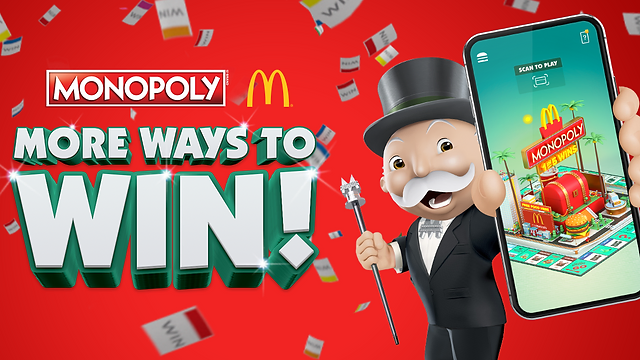
In addition to its traditional loyalty offerings, McDonald’s has successfully integrated gamified experiences to further engage users and drive app usage. Seasonal promotions such as Monopoly, which allows customers to collect game pieces for a chance to win prizes, have been instrumental in increasing digital engagement. In 2025, TIKR reported that McDonald’s Monopoly generated nearly 500 million plays [7].
This gaming aspect taps into the thrill of competition and the allure of winning, encouraging customers to make more frequent purchases and engage with the app.
Gamified activities like the Monopoly promotion, in-app challenges, and bonus point campaigns have contributed to increased digital engagement. By making the process of earning rewards fun and interactive, McDonald’s ensures that customers return not only for the food but also for the engaging digital experiences that keep them connected to the brand.
Conclusion
MyMcDonald’s Rewards has made a big splash in the QSR industry, showcasing how a well-crafted loyalty program can boost customer engagement and business performance.
The program’s success stems from its user-friendly mobile app integration, personalised offers and seamless user experience. These features have led to increased customer loyalty, higher average order values and valuable insights into customer behaviour.
The program’s impact is clear. Globally, McDonald’s reported nearly 210 million 90-day active loyalty users across 70 markets at year-end 2025. Systemwide sales to loyalty members also increased to nearly US$37 billion for the full year [1].
The lessons from MyMcDonald’s Rewards are applicable across various industries, highlighting the importance of data-driven strategies and personalised experiences in building customer relationships. As businesses strive to enhance their loyalty programs, it’s crucial to focus on creating value for members while gathering actionable insights.
To find out how to optimise your loyalty program, reach out to Loyalty & Reward Co. The success of MyMcDonald’s Rewards serves as a reminder that a well-executed loyalty strategy can be a game-changer in today’s competitive market.
Do Loyalty Programs Work? Explore other examples of winning loyalty programs here.

References
[1] McDonald’s, 2026, ‘McDonald’s Reports Fourth Quarter and Full Year 2025 Results’, accessed May 2026. Retrieved from https://corporate.mcdonalds.com/corpmcd/our-stories/article/Q4-full-year-2025-results.html
[2] McDonald’s, 2024, ‘Digitizing the Arches’, accessed May 2026. Retrieved from https://corporate.mcdonalds.com/corpmcd/our-stories/article/digitizing-the-arches.html
[3] Customer Experience Dive, 2025, ‘McDonald’s loyalty program is making progress, but executives see work ahead’, accessed May 2026. Retrieved from https://www.customerexperiencedive.com/news/mcdonalds-loyalty-program-is-making-progress-but-executives-see-work-ahea/756997/
[4] McDonald’s, 2026, ‘MyMcDonald’s Rewards: Earn McDonald’s Points for Free Food’, accessed May 2026. Retrieved from https://www.mcdonalds.com/us/en-us/mymcdonalds.html
[5] eMarketer, 2024, ‘Q&A: McDonald’s on the role of data in increasing customer loyalty’, accessed May 2026. Retrieved from https://www.emarketer.com/content/q-a-mcdonald-s-on-role-of-data-increasing-customer-loyalty
[6] McDonald’s, 2026, 2025 Annual Report, accessed May 2026. Retrieved from https://corporate.mcdonalds.com/content/dam/sites/corp/nfl/pdf/MCD%202025%20Annual%20Report.pdf
[7] TIKR, 2026, ‘McDonald’s Loyalty Members Visit 2.5x More Often: Why Numbers Points to a $465 Target’, accessed May 2026. Retrieved from https://www.tikr.com/blog/mcdonalds-loyalty-members-visit-2-5x-more-often-why-numbers-points-to-a-465-target