

Editor’s note, May 2026: We first published this article in March 2022 and originally reviewed the Hotels.com Rewards stamp-card program. Since then, Hotels.com has moved customers towards One Key, Expedia Group’s broader travel rewards program. This update keeps the original analysis as historical context and adds a 2026 note on what changed.
I don’t know about you but, after two years of being stuck at home, I was desperate to start travelling again. I was also nervous about the cost of travelling and curious to see if prices would spike as the travel industry recovered from COVID.
Then I found Hotels.com Rewards. Hotels.com allows customers to compare prices across a range of different hotels and get rewards at the same time. The loyalty program strategy doesn’t limit you to one hotel brand, but instead allows you to move from place to place with your rewards counting towards the same goal. But are the benefits worth it?
The original Hotels.com Rewards program
The original Hotels.com Rewards program reviewed in this article operated via a stamp-card system, where members received one stamp for every eligible night stayed. Once members acquired ten stamps, they received a reward night, along with additional benefits depending on their tier.
Customers could join from the homepage or at the point of purchase. From there, they were asked to provide their name, email and password, and the earning could begin.
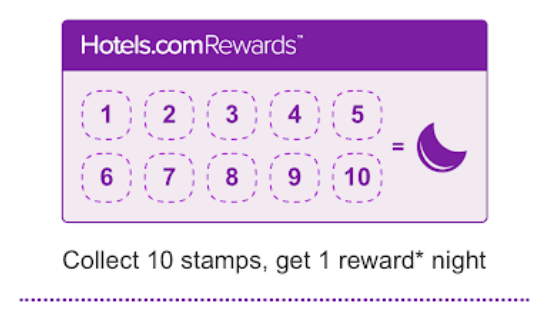
When making a booking, the member’s stamp card would automatically change to reflect the number of eligible nights paid for. Once the stamp card reached 10, it would restart. This was made easy by the app, which tracked member progress.
Hotels.com Rewards benefits
Along with the reward night, members could receive additional benefits with each tier. There were three tiers available, where members accumulated perks the more they stayed. See below for a summary of the member benefits under the original Hotels.com Rewards model.
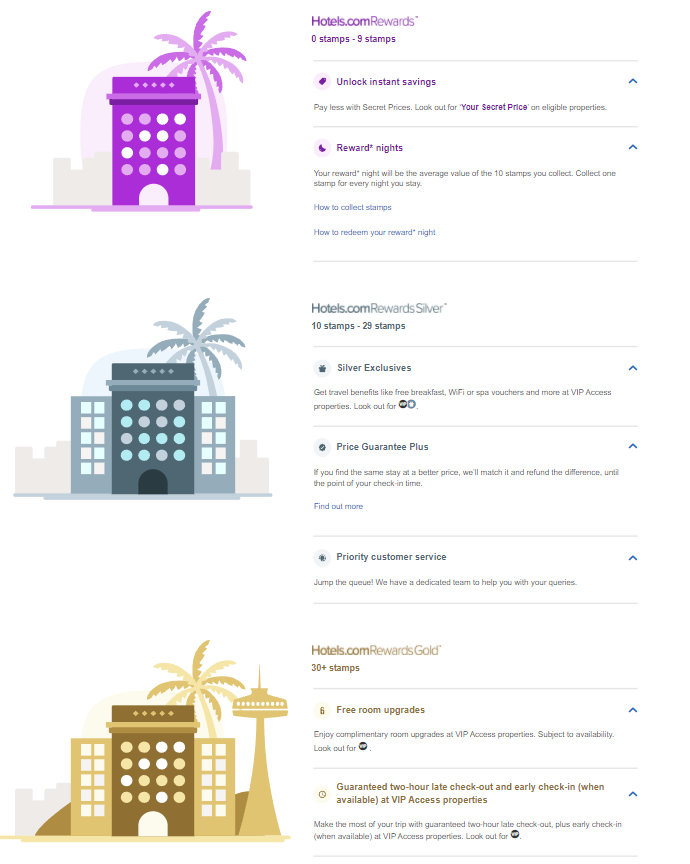
Personally, the key highlights were the free room upgrades, although only available at select properties, and the price guarantee plus. This was where members could be offered a lower price on Hotels.com if they found the same stay somewhere else at a lower price.
The secret prices were effective as they offered instant value to customers. However, despite being listed in the first member tier, this was a benefit available to anyone who subscribed or downloaded the app. A pretty easy way to receive instant value without even having to become a member. Hotels.com could have considered offering this, or a larger discount, as a member-only benefit.
How members redeemed Hotels.com Rewards
Redeeming a Hotels.com Rewards night involved three easy steps:
- Sign into your account and search eligible properties (which you can filter).
- Once you’ve chosen a property, select ‘pay online’.
- At checkout, select ‘apply Hotels.com Rewards’ and choose the night you want to redeem.
If the reward night was worth more than your credit, you paid the difference. This created a potential opportunity for Hotels.com, as customers are generally more likely to spend more if they have a discount. However, if the stay cost less than the credit, the member forfeited the difference.
The value of Hotels.com Rewards
An interesting aspect of the original Hotels.com Rewards program was that it combined the stamp card with status tiers. This meant members not only earned a reward night after collecting 10 stamps, but could also unlock additional benefits.
In terms of the reward night, members received a stay based on the average value of their 10 nights. This structure was effective because it allowed members to receive value based on their own individual spending. In contrast, other programs may have one set dollar amount that members need to reach, such as spending over $250 to receive $10 off. The risk is that some members may not be able to spend the required amount and will therefore miss out on value.
Another valuable aspect of the loyalty program strategy was that it didn’t restrict members to one stamp per stay. Instead, the program offered one stamp per night. The stamps required to receive a reward night could be based on ten individual stays, or a collective ten nights in one stay. So, in theory, you could go on a one-week vacation and already be two-thirds of the way to receiving your reward.
Challenges
The loyalty program strategy was simple and provided some attractive benefits, but it did present some challenges:
- Benefits like room upgrades, late check-outs or tier exclusives were only available at selected VIP properties.
- If your reward night cost less than your credit, you lost the difference.
- Your reward night expired if you did not book within the required period.
- You couldn’t combine your reward night with other discounts being offered.
Summary
Overall, I liked the original Hotels.com Rewards program. Its simplicity meant it was easy to use and understand. As someone not loyal to one hotel brand, Hotels.com allows me to compare stays and get rewards at the same time. However, I realise that customers who are loyal to specific hotel brands may find more value in being a member of that particular hotel program.
To address some of the challenges of the original loyalty program strategy, Hotels.com could have considered simple changes like extended expiry or offering members the chance to keep leftover credit to put towards another stay.
2026 update: What happened to Hotels.com Rewards?
Since this article was first published, Hotels.com Rewards has changed significantly. The old stamp-card model, where members collected 10 stamps to earn a reward night, is no longer the rewards program promoted through Hotels.com.
This is a shame, because the original Hotels.com Rewards program had a lot going for it. It was old-school, but in the best way. Members understood the value exchange: stay 10 nights and earn a reward night based on the average value of those stays. There was no complicated points maths, no vague conversion rate and no need to understand multiple travel brands before seeing the benefit.
Instead, Hotels.com now points many customers towards One Key, Expedia Group’s broader travel rewards program. One Key members can access member prices and earn OneKeyCash on eligible bookings. OneKeyCash can then be used on eligible bookings through Hotels.com, Expedia and Vrbo.
From a business perspective, the move makes sense. Expedia Group can use One Key to connect Hotels.com, Expedia and Vrbo under one rewards currency. However, from a member perspective, the shift has not been universally well received. Some travellers have criticised One Key for feeling more complicated and less valuable than the original Hotels.com Rewards stamp-card model.
This is the loyalty challenge. A broader group-wide currency can create more flexibility, but it can also weaken a distinctive program if members feel the new structure is harder to understand or less generous. Hotels.com Rewards may not have been sophisticated, but that was part of its appeal.
To make things more confusing, Hotels.com has also relaunched a separate Hotels.com Rewards model in the UK in 2026, offering members £100 in Hotels.comCash after every 10 eligible hotel nights. This reinforces the need for members to check the current rewards terms in their own market before booking.
Looking to optimise your loyalty program strategy?
Our loyalty consultants have extensive experience in loyalty across various global clients and can help you to take the critical steps to design an effective loyalty program that addresses your key business objectives. Contact us to learn more about our comprehensive loyalty services and talk with our loyalty consultants to understand how to develop or optimise your loyalty program strategy.